
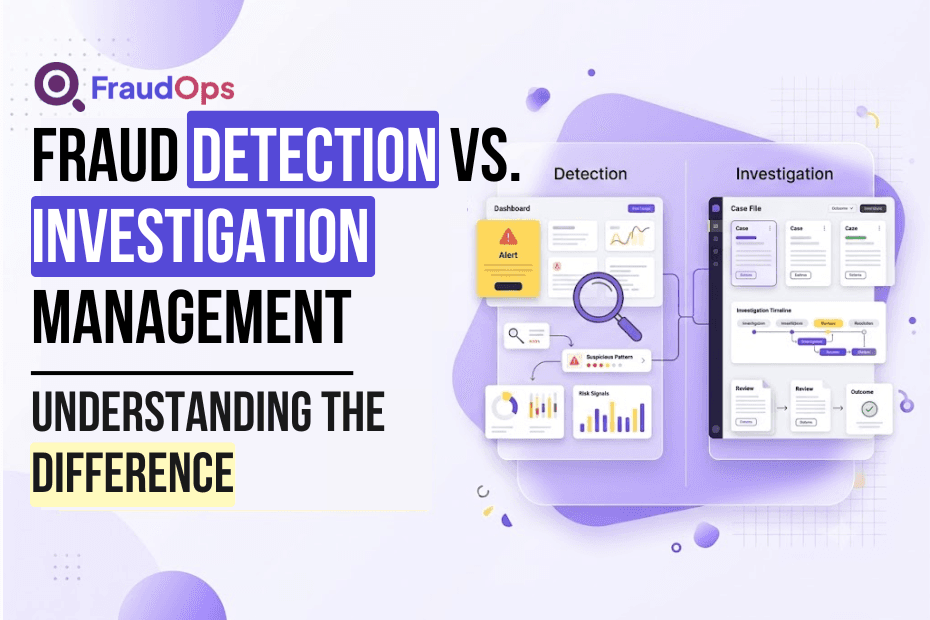
Fraud detection and investigation management are different jobs. Detection scores claims and surfaces the suspicious ones; investigation management is what happens after the alert fires — working the referral into a confirmed outcome, a recovery, or a cleared claim. Detection finds the signal. Investigation management turns it into a result.
That distinction sounds obvious written down. In practice, most insurers have spent a decade buying the first and assuming the second would look after itself. It hasn’t. The detection layer now produces more referrals than the investigation function can work, and the gap between the two is where savings quietly leak away.
The Two Jobs, and Why They Get Confused
Detection is a scoring problem. A model — Quantexa, SymphonyAI, NetReveal, a voice-risk score from Clearspeed, a match against the IFB or IFR feeds — looks at a claim or an application and decides how suspicious it is. The output is a flag, a score, an alert. Good detection is precise: it surfaces the right claims and wastes as little investigator time as possible on the wrong ones.
Investigation management is a workflow problem. Once a claim is flagged, someone has to own it, gather the evidence, run the searches, decide whether the suspicion holds, record the outcome, and capture what was saved. That work spans LexisNexis, Experian, DVLA, Companies House, the internal claims system and half a dozen other sources, one case at a time. The output is not a score. It is a decision, an audit trail, and — when it goes right — money kept in the business.
The two get confused because detection vendors sell the alert as if it were the outcome. A high-scoring claim is not a saving. It is a referral that still has to be worked by a person. Treating the score as the finish line is how a fraud function ends up measuring how loud its detection layer is rather than what its investigators actually recovered.
Why The Gap Has Widened
Detection has scaled. Investigation capacity has not. That is the whole problem in one sentence, and the UK numbers behind it are not subtle.
UK insurers detected £1.16 billion of fraudulent general insurance claims in 2024, across more than 98,400 cases — a 12% rise in case volume on the year before (ABI, November 2025). Motor alone accounted for 51,700 detected scams worth £576 million. On the application side, insurers prevented an estimated 684,800 fraudulent applications, up 7.4% on the previous year. Every one of those detected cases is a referral that landed on someone’s desk.
The detection layer keeps getting better at producing them. The LexisNexis Insurance Fraud Research Report 2025/26 found 83% of fraud leaders reporting a rise in opportunistic claims fraud and 52% flagging organised fraud as a growing concern, against a backdrop of more than 300 million transactions screened a day and one in every hundred applications carrying a strong fraud marker. Cifas tells the same story from the identity angle: insurance cases on the National Fraud Database rose 26% in 2025, to more than 16,000 (Cifas Fraudscape 2026).
More detection produces more referrals. It does not produce more investigators. The result is a backlog that grows faster than the team can clear it, and a conversion rate — referrals worked through to a confirmed outcome — that nobody is watching closely because the headline number, alerts generated, keeps going up and looks like progress.
Fraud Detection vs Investigation Management, Side by Side
| Fraud detection | Investigation management | |
|---|---|---|
| The job | Score claims and applications, surface the suspicious ones | Work the surfaced referral through to a confirmed outcome |
| Where it sits | At intake and across the claim lifecycle | Downstream of detection, once an alert exists |
| Typical tools | Quantexa, SymphonyAI, NetReveal, Clearspeed, IFB / IFR feeds | A case system, plus Excel, Outlook and a dozen data portals |
| Output | A flag, a score, an alert | A decision, an audit trail, an indemnity saving |
| Measured by | Hit rate, false-positive rate, coverage | Conversion rate, cycle time, identified fraud, backlog |
| Owned by | Detection / analytics / data science | The SIU and investigation team |
| What “good” looks like | Precise alerts, fewer wasted referrals | Referrals worked fast, consistently, and defensibly |
The table makes the point the market keeps missing: these are complementary, not competing. A precise detection layer feeding a fast, consistent investigation function is a fraud operation that works. A precise detection layer feeding a fragmented, manual investigation function is a backlog with good telemetry.
What Investigation Management Actually Involves
Strip away the jargon and investigation management is four things done well, repeatedly, under scrutiny.
- Intake and ownership: every referral routed into a managed queue, assigned to a named investigator, with status visible to whoever needs it. No referrals lost in an inbox.
- Evidence and intelligence: the searches across data vendors and intelligence sources, the documents read, the connected parties and cases identified. This is where investigators lose the most time, switching between seven tabs and re-keying the same details.
- Decision and outcome: the determination, the recovery or decline, the indemnity figure captured against the case rather than reconstructed at month-end.
- Control: a record of who did what, when, and why — the audit trail that makes an investigation defensible if a complaint or a regulator asks how a decision was reached.
Done on spreadsheets and email, each of these is a manual job that depends on the individual investigator’s diligence and memory. Done on a single surface, they become a repeatable process the whole team runs the same way. That shift — from individual effort to managed operation — is what “investigation management” actually names.
Why The Gap Matters Now, Not Just Operationally
There is a second reason the post-detection gap has stopped being a tolerable inefficiency. Cycle time is now a fair-treatment question. The FCA’s July 2025 review of home and travel claims handling found firms leaning too heavily on process-based MI and lacking direct evidence of what customers actually experienced at the claims stage (FCA). A genuine claimant held in a long investigation because the queue was backed up is not only an operational miss; it is a treatment issue the board has to be able to see.
Detection cannot answer that. Detection tells you a claim looked suspicious. Only the investigation record can show that the suspicion was tested properly, the decision was sound, and the honest claimant was not made to wait while the team worked through a backlog. The evidence the regulator wants lives downstream of the alert, in the investigation management layer — which is precisely the layer most insurers have under-invested in.
Closing The Gap
The fix is not more detection. The detection pipeline is already full; buying another scoring engine adds referrals to a queue that is already too long. The fix is to give the investigation function the same operational maturity the detection layer already has.
That is the job an investigations workbench does. FraudOps sits downstream of the detection systems and turns the referral pipeline into worked cases on a single surface: intake, evidence, intelligence, decision and outcome in one place, instead of across seven tabs and a spreadsheet. Its matching engine runs across parties, past cases, connected data and the intelligence database to surface linked claims and organised activity. Three AI agents — the Case Handler Agent, the Intel Agent and the Investigation Assistant Agent — accelerate the routine work, while every decision stays human-in-the-loop with a full audit trail. AI does the chasing; the investigator makes the call.
The numbers from running it that way are real: 50,000-plus settled investigations managed, £150 million-plus of suspected claims handled, a 95% decrease in outstanding referrals, and 25 to 30% faster investigation completion year on year — now live with a Tier 1 UK insurer and a UK TPA. A 95% cut in the backlog is what closing the post-detection gap looks like in practice: not better alerts, but more of the alerts you already have worked through to an outcome.
Conclusion
Detection and investigation management are not the same job, and treating them as one is how fraud operations end up data-rich and outcome-poor. Detection finds the suspicious claim; investigation management decides what happens to it, captures the saving, and stands the decision up to scrutiny. The UK’s detection layer is already producing more referrals than most teams can work — so the next gain is not another scoring engine, it is the operational layer that turns those referrals into results.
Frequently Asked Questions
1. What is the difference between fraud detection and investigation management?
Fraud detection scores claims and applications and surfaces the suspicious ones as alerts or referrals. Investigation management is what happens next: working each referral through evidence, intelligence and a decision to a confirmed outcome, with the saving captured and an audit trail recorded. Detection finds the signal; investigation management turns it into a result.
2. Isn’t investigation management just case management?
It includes case management but is broader. Case management is the container for a single case. Investigation management spans the whole post-detection operation — routing referrals into a managed queue, running intelligence and evidence work, surfacing linked cases, recording outcomes and savings, and giving leaders visibility of conversion, cycle time and backlog across the team.
3. Does an investigations workbench replace our detection tools?
No. An investigations workbench sits downstream of detection and works the referrals it produces. Tools like Quantexa, SymphonyAI, Clearspeed and the IFB and IFR feeds keep doing the detection; the workbench connects to them, pulls their scores into the case, and turns the alert into a worked outcome. They are complementary layers, not alternatives.
4. Why is the gap between detection and investigation a problem now?
Detection has scaled faster than investigation capacity. UK insurers detected £1.16 billion of fraud across 98,400-plus cases in 2024, and referral volumes keep rising while teams stay the same size. The result is a growing backlog, a falling conversion rate, and longer cycle times — which, under fair-treatment scrutiny, is also a regulatory exposure, not just an operational one.