When a motor fraud referral lands in an SIU investigation queue, the instinct is to work it as a case. Review the claimant’s details, check the accident circumstances, look for indicators that do not add up, reach a determination, and close the case. For opportunistic fraud, that approach works well enough. For organised fraud, it consistently misses the point.
The fraud that accounts for the most significant financial losses and the hardest repudiation decisions is rarely committed by someone acting alone on a single claim. The ABI’s November 2025 analysis of UK insurance fraud trends described the situation clearly: organised fraud rings remain one of the most serious concerns across the industry, coordinating complex schemes across multiple claims, policies, and often multiple insurers simultaneously. Investigating each of those claims as a standalone case means catching one instance of a much larger operation, frequently without any visibility that a broader network even exists behind it.
Key Takeaways
- Organised fraud rings exploit individual case investigations by coordinating multiple claims across various participants, masking their activities.
- Insurance fraud network link analysis connects shared data points to reveal patterns that traditional case reviews often miss.
- Entity linking creates a unified view of fraud-related entities, enhancing the ability to track complex fraud operations.
- The scale of organised fraud in the UK underscores the need for a network view to understand and disrupt these schemes effectively.
- FraudOps integrates network intelligence directly into investigations, supporting proactive strategies against organised fraud.
How Organised Fraud Rings Actually Operate
Understanding why individual case investigation struggles with organised fraud starts with understanding how these operations are structured. A well-run fraud ring does not rely on a single claimant submitting multiple claims. It uses a coordinated network of participants, each contributing a role to a larger scheme while appearing, on any individual case review, to be an unconnected ordinary claimant making a routine submission.
As the ABI highlights, effective fraud prevention depends on the stability of robust rules, the power of AI, and the reach of real-time network analytics, which connects the dots across complex networks to uncover organised fraud that traditional methods can miss. Rings coordinate mule accounts, assets, addresses, phone numbers, repairers, and legal representatives across multiple claims simultaneously. A staged motor accident might involve a driver, several passengers submitting separate injury claims, a network of referring solicitors, and a medical reporting company with connections to prior fraud operations. None of those elements, viewed in isolation on a single case, necessarily presents as fraud. Viewed together across multiple claims, the pattern of connections becomes the evidence.
The IFB’s intelligence work on organised fraud reflects exactly this dynamic. Identifying and disrupting fraud rings requires connecting data points across the industry, because the individual claim record at any single insurer rarely tells the whole story. One insurer might hold data on the driver. Another has two of the passengers. A third has a prior connection to the solicitor involved. Without a mechanism for connecting those data points, the ring continues operating across the gaps between insurers that do not share a common view of the network.
What Insurance Fraud Network Link Analysis Does Differently
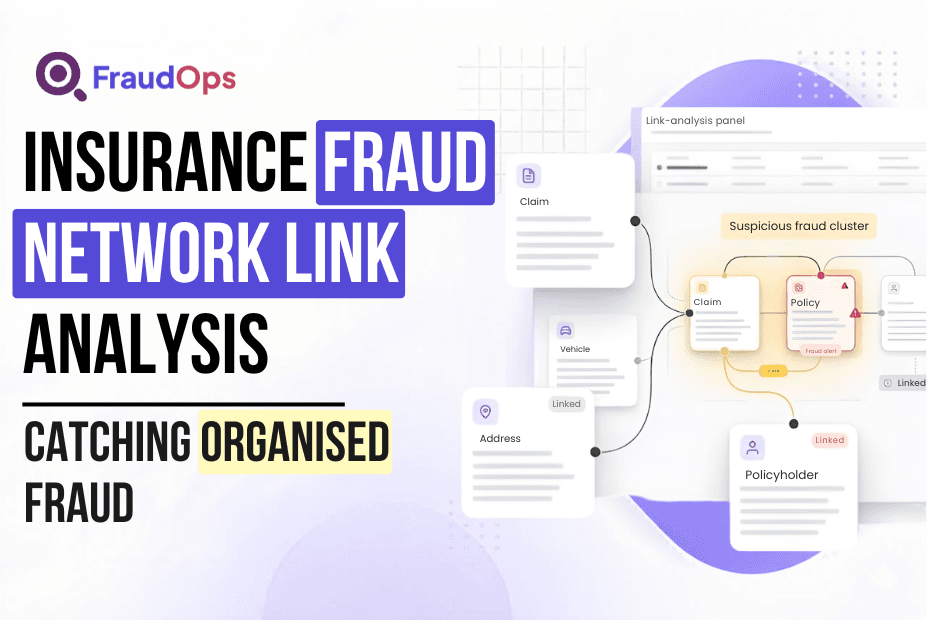
The approach that changes this picture for SIU teams is what counter-fraud professionals refer to as insurance fraud network link analysis: a structured method of identifying and mapping the connections between entities across cases and data sources, rather than reviewing each claim record independently as a self-contained problem.
At its most direct, link analysis connects shared data points that individual case review would never surface. Two claims sharing the same phone number. Three policies linking back to the same address. A solicitor appearing on a series of injury claims across different insurers over the same six-month period. A vehicle showing up in multiple incidents under different circumstances. Each of those connections exists somewhere in the data. What link analysis does is surface them systematically, so that a pattern of relationships which is invisible when examining individual cases becomes visible as a coordinated network.
The Role of Entity Linking in Insurance Fraud Detection
The more sophisticated version of network analysis involves what is known as entity linking in insurance fraud investigation: the process of building a unified view of each real-world entity across multiple data sources, so that the same person, vehicle, address, or business appears as a single node in the network rather than as a set of disconnected records spread across different systems.
This matters operationally because fraud rings deliberately exploit the gaps between records. A claimant might use a slightly different name or address variation across two claims. A vehicle might appear under different registration details in separate incidents. A solicitor firm might trade under multiple names across different operations. Entity resolution technology for insurance fraud applications addresses this directly: it identifies that two superficially different records actually refer to the same real-world entity, and connects them into a unified view. Once that view exists, the network of connections between entities becomes visible across claims, policies, and data sources that were previously siloed from one another.
The Organised Fraud Detection Problem UK Insurance Teams Are Sitting With
The scale of organised fraud makes the operational argument for improving organised fraud detection in insurance increasingly difficult to defer. The ABI’s 2024 detected fraud data put total fraudulent general insurance claims across the UK market at £1.16 billion, with organised rings accounting for a disproportionate share of the highest-value cases.
Working this volume of activity through individual case investigation, without a network view connecting claims across the operation, produces a consistent and predictable pattern. Teams close individual cases without realising they represent part of a larger scheme, the ring continues operating, and the total losses attributed to it keep climbing until something external triggers a broader review. The organised fraud detection challenge for UK insurers and counter-fraud teams is not primarily about detecting individual suspicious claims. It is about identifying the network structure behind those claims and acting on it before the ring moves on.
Standard SIU MI reporting compounds this problem. Total fraud savings, referral volumes, and investigation throughput are all reported in aggregate. Organised fraud networks spanning multiple cases rarely appear as a distinct line in that reporting, which means the full cost of a ring’s activity stays invisible until the ring is disrupted and the connected cases are counted retrospectively. A team can be performing well on individual case metrics and still be significantly underperforming on organised fraud simply because the network view does not exist in the data they are reviewing.
What a Fraud Ring Investigation Looks Like With Network Intelligence Available
The practical effect of having a network view available during fraud ring investigation is that investigators can build a connected case strategy from the outset rather than discovering the network halfway through or not at all. Instead of closing a motor fraud referral and moving to the next item in the queue, an investigator with access to entity linking across the case database can see that the claimant shares a phone number with three other open cases, that the solicitor involved has appeared on eleven prior claims across two other insurers, and that the vehicle has two prior incidents under different policies within the same twelve months.
That network view changes both the investigation strategy and the outcome. A connected case file supports repudiation across multiple claims simultaneously rather than requiring each case to be worked to conclusion independently. Intelligence gathered on one case enriches the investigation of the others. A referral to IFED or the IFB with the full network picture behind it is considerably more actionable than a single-case referral that gives the receiving organisation no visibility of the wider operation.
For counter-fraud teams across UK insurers, this is the gap that network intelligence closes: the difference between investigating fraud case by case and investigating the organisation behind the fraud.
How FraudOps Supports Network Intelligence and Organised Fraud Investigation
FraudOps builds network intelligence capability directly into the investigation workflow. Individual cases can be grouped into Operations for coordinated work on organised fraud, with connected claims, shared identities, and repeat modus operandi visible across the underlying case set from a single view. An enterprise search across all past and current cases, intelligence records, and documents means a new referral can be matched against existing intelligence immediately, without an investigator manually cross-referencing previous case files or running searches across separate systems.
The Intel Agent automates searches across connected data sources with results feeding into the case and contributing to the entity picture rather than sitting in a separate lookup. Every connection identified is recorded in the audit trail and contributes to the intelligence picture available for future referrals in the same network.
The Bottom Line
The counter-fraud teams making the most impact on organised fraud are the ones that have moved beyond treating each referral as a self-contained problem. The data connecting organised fraud operations is usually available somewhere across the case and intelligence record. What has historically been missing is the mechanism for connecting it systematically, so that the network becomes visible before the ring has closed its latest batch of claims and moved on.
The discipline of insurance fraud network link analysis is not a replacement for investigation judgement. The investigator still makes the determination on every case. What it changes is what the investigator can see when they make that determination, and how much of the organised fraud operation they can act on as a result.
If your SIU is closing cases on claims that share entities with other cases already in your own investigation queue, the practical question worth asking is how you would know.