If you have spent time in a counter-fraud team over the last few years, you will have sat through more than one conversation about what AI is going to do to insurance fraud investigation. Some of those conversations have been genuinely useful. Others have been vendor presentations suggesting the entire fraud problem was about to be solved by a single platform, which is not quite how things have played out. What the data on AI in insurance fraud investigation is actually showing across UK teams in 2026 is more specific, and more practically useful, than the broader hype suggested. The technology is making a genuine difference in particular, well-defined areas. The challenge for SIU leaders is knowing which areas those are, and where the promises have still not matched operational reality.
Key Takeaways
- AI in insurance fraud investigation is making measurable impacts in specific areas like document review and open-source intelligence, but it faces challenges.
- Detection AI works upstream of the investigation process to identify potential fraud, while investigation AI assists in examining cases once referrals are made.
- Expectations often exceed reality, particularly with detection AI, which struggles with false positives in live conditions.
- Successful organizations combine AI tools seamlessly with investigator workflows, enhancing efficiency and analysis capabilities.
- Overall, AI is a tool to support fraud professionals, not a replacement, as the problem of fraud becomes increasingly complex.
The Distinction That Most of the AI Conversation Gets Wrong
The most persistent source of confusion in discussions about AI and fraud investigation is the failure to separate two applications that operate at fundamentally different points in the claims process. Detection AI and investigation AI are not the same thing, they do not solve the same problems, and treating them as interchangeable is one of the main reasons expectations have sometimes landed significantly ahead of results.
Detection AI operates before a referral reaches the SIU. The machine learning models running across incoming claims portfolios, the pattern recognition identifying anomalies across millions of data points, the scoring systems producing an alert that drops into an investigation queue, and all of this is detection work happening upstream of the investigation layer. The UK insurance market has invested heavily in detection capability over the last decade, and for high-volume personal lines books those models have become genuinely sophisticated.
Investigation AI operates after referral, inside the case itself. Document summarisation, automated data lookups, entity enrichment across intelligence databases, and cross-case pattern matching to surface connections between a new referral and prior cases are the tools that help investigators work through what has been referred to them. This is a considerably less developed space than detection, and it is where the gap between what AI can theoretically do and what is actually embedded in SIU workflows tends to be widest. A detection scoring tool that operates well at intake is a different product category to the AI fraud investigation software UK investigation teams use to build and progress cases once the referral has arrived. Understanding that distinction is the starting point for any sensible conversation about what to invest in and what to expect.
What AI in Insurance Fraud Investigation Is Actually Delivering Right Now
The categories where counter-fraud teams across UK insurers are getting consistent operational value from AI are narrower than the vendor market suggests, but within those categories the results are real and measurable.
Document review is one of the clearest wins. The volume of documentation attached to a typical motor or liability claim, covering medical reports, vehicle inspection records, witness statements, and invoices, is large enough that having an AI layer identify relevant sections, flag internal inconsistencies, and highlight facts that require investigator attention materially reduces the time an investigator spends reading before they can start analysing. Aviva has publicly identified AI-generated images and manipulated documents as a growing operational problem across its portfolios, which means document review now serves a dual purpose: extracting relevant facts from legitimate documentation and assessing the credibility of whether the document itself may have been artificially produced.
Open source intelligence, applied within a proper legal framework, is another area generating real results. Social media review that once required hours of manual searching can now be structured and directed much faster by AI tools, giving investigators usable coverage across publicly available material that would previously have been impractical at case volume. The legal framework is significant here: UK SIU teams using AI for OSINT need a documented legal basis for processing personal data under GDPR, with data minimisation obligations applying equally to AI-assisted searches as to manual ones. The advantage the technology brings is speed and coverage, not exemption from the legal constraints that govern how intelligence can be used or presented as evidence.
Cross-case pattern matching, which surfaces connections between a new referral and prior cases, intelligence records, and known fraud networks, is where the insurance fraud AI tools UK counter-fraud operations are deploying are having the most meaningful impact on organised fraud. IP address clustering, shared entity connections across claims, and duplicated claim characteristics across different insurers are signals that are essentially invisible at individual case level and only become visible when an AI layer is operating across a sufficiently large dataset.
Where the Hype Has Run Ahead of the Reality
The area where expectations have most consistently outpaced delivery is detection model performance in live operational conditions. Machine learning models achieving strong detection rates in controlled pilots, trained and tested on clean, well-labelled historical data, do not always hold those rates once deployed against live claims. Real claims data is messier and more varied than training sets, fraud tactics evolve faster than models retrain, and a false positive rate that looks manageable in a pilot environment becomes operationally expensive when it is generating several hundred unnecessary referrals a week into an already stretched investigation queue. Some SIU teams that invested in detection AI expecting to reduce investigation workload have instead found it increased referral volume without a proportional increase in confirmed savings.
The arms race dimension is also more genuinely balanced than optimistic assessments suggest. Browne Jacobson’s December 2025 analysis of AI in insurance fraud made the point directly: fraudsters are using generative AI to produce convincing fake images, documents, and supporting claim materials at a pace that creates a real and ongoing challenge for detection. The insurance fraud detection software designed to identify manipulated documents is competing against tools that are being refined at least as quickly on the other side. The Insurance Times analysis of AI in fraud from March 2026 described this as a healthy but uncomfortable tension, with faster straight-through processing on one hand and fraudsters making increasing use of agentic AI on the other. There is no settled advantage, and SIU leaders who have been told otherwise should ask for specifics on false positive rates and retraining cycles.
What the Results Look Like When It Is Working Well
The most credible evidence of what AI-assisted fraud investigation is delivering comes from named UK insurers with publicly reported, auditable outcomes. Allianz UK prevented almost £174 million in fraudulent claims across 2025, a record for the business and a 10.5 per cent increase on 2024, using an investigation approach that combines machine learning models with voice analytics and external data partnerships. Allianz identified more than 34,200 suspected fraud cases in 2025 across personal, commercial, and specialty lines. Aviva recorded its highest-ever volume of detected claims fraud in the same period, with AI-generated images and manipulated documents identified as a growing challenge requiring sustained investment to address.
These results are significant, and they are the product of multi-year investment in both detection and investigation capability rather than any single platform deployment. The ABI’s November 2025 analysis recorded £1.16 billion in detected fraudulent claims in 2024, which frames the scale of the problem these investments are working against. The Government’s Fraud Strategy 2026 to 2029, published in March 2026 and backed by £250 million over three years, signals that the expectation from regulators and government is for this investment to continue increasing across the UK insurance market.
How FraudOps Puts AI Into the Investigation Workflow
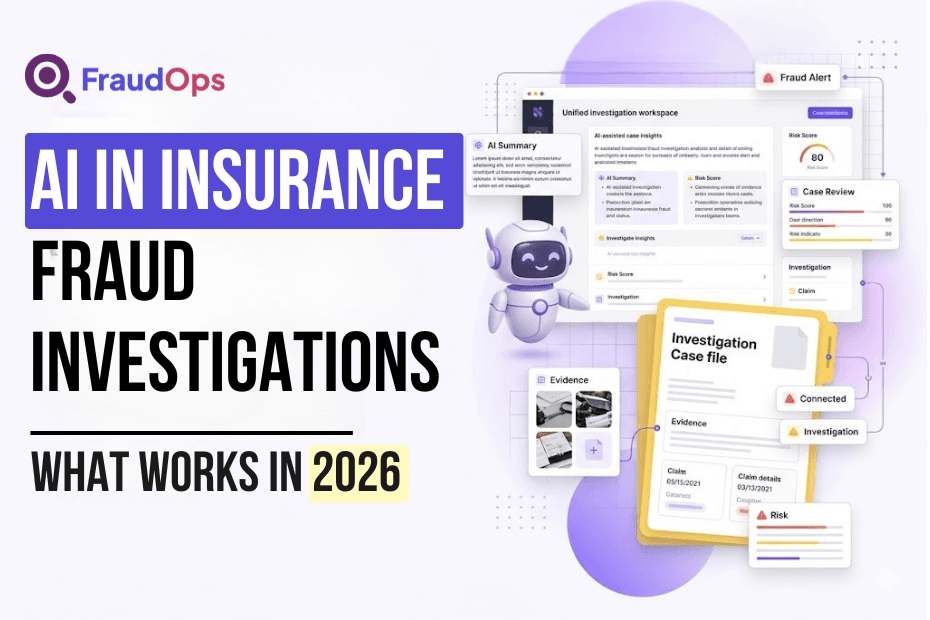
What FraudOps provides for UK SIU teams is AI built into the investigation workflow rather than operating alongside it as a separate tool. The Case Handler Agent reads unstructured documents including medical reports, witness statements, and referral emails, and populates structured case fields before the investigator reviews the referral in detail. The Intel Agent automates searches across connected data sources from inside the case, with every lookup recorded in the audit trail. Enterprise search across all past and current cases, intelligence records, and documents matches a new referral against existing intelligence in real time, giving the investigator a connected network view at the point the referral arrives rather than after a period of manual cross-referencing.
Every AI action within the platform is visible, auditable, and can be reviewed or overridden, because the investigator makes every determination. In a regulated environment where fraud repudiations need to be evidenced, auditable, and defensible at the FOS, human oversight of every AI-assisted output is both an operational requirement and a Consumer Duty obligation. The goal of the automated SIU workflow software that actually works in practice is to handle the assembly, retrieval, and enrichment work so that the investigator’s time goes on the analysis and decision-making that produces the outcome.
Bottom Line
The honest picture of AI in insurance fraud investigation in 2026 is that the technology is delivering real, measurable results in specific areas, covering document review, OSINT structuring, cross-case pattern matching, and automated data lookups, while the broader promise of AI-driven detection as a comprehensive solution to the fraud problem has not fully materialised. The teams getting the best outcomes are using AI to reduce the assembly and retrieval work that consumes investigator time, freeing experienced people for the analytical work that determines whether a referral converts into a confirmed saving.
The fraud problem is getting harder at the same time. AI-generated evidence is making document authenticity harder to assess quickly. Organised fraud rings are adapting to detection models. The ABI’s confirmed fraud figures, at over a billion pounds a year in detected fraud alone, make clear that detection alone is not a sufficient response. The SIU operations making consistent progress are treating AI as a tool that makes investigators faster and better informed, rather than a replacement for the experienced counter-fraud professional who has to make the call at the end of every case.
For a closer look at how these capabilities come together in one workbench, see our SIU case management software overview.