
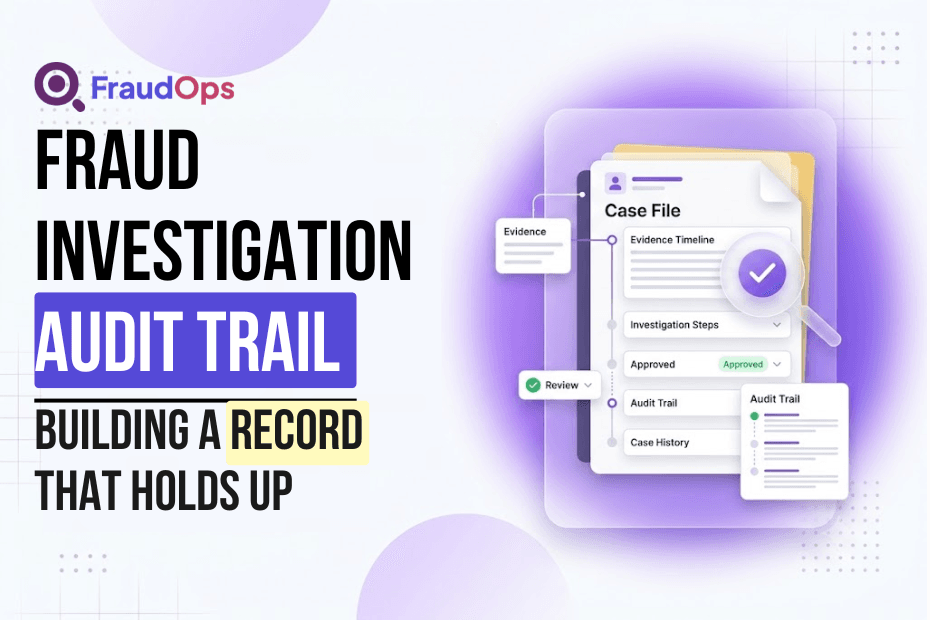
A fraud investigation audit trail is defensible when it records the decision, the named person who made it, the evidence behind it, the searches run, any AI-assisted action with the human sign-off, and the timestamps for each. It must be retained under clear rules and access-controlled, so the full story can be reconstructed long after the case closes.
That is the standard. Most teams fall short of it not through poor work but through poor record-keeping. The investigation was sound. The trail proving it was sound never got assembled in one place.
Why The Trail Matters More Than The Decision
A repudiation, a delayed payout, or a referral that goes nowhere is only as good as the record sitting behind it. When a complaint lands, or when the Financial Ombudsman Service picks up a case, nobody re-runs the investigation. They read the file. If the file cannot show what was decided, who decided it, and on what evidence, the work effectively did not happen.
The numbers give the activity its scale. UK insurers identified £1.16 billion of fraudulent general insurance claims in 2024, across more than 98,400 detected cases, a 12% rise in volume on 2023 (ABI). The pressure is still building: Cifas recorded more than 16,000 insurance cases on the National Fraud Database in 2025, up 26% on the year (Cifas Fraudscape 2026). Every one of those decisions to suspect, investigate, repudiate or pay carries an expectation that it was reached fairly and can be evidenced.
The common failure is mundane. Many SIUs still keep the trail across spreadsheets, shared inboxes and individual investigators’ notes. That holds up while the case is live and the investigator is at their desk. It falls apart under a complaint, an ombudsman referral, or a reviewer who wants to see the whole population of declined claims and how each was handled.
Why “We Investigate Properly” is No Longer Enough
A declined claim is a consumer outcome, and the expectation now is that the firm can evidence the decision was fair relative to the policy, reached promptly and communicated properly, rather than simply assert it (FCA Consumer Duty). The FCA’s July 2025 review of home and travel claims handling made the documentation point sharply: minutes of key claims committee meetings often lacked the detail to show meaningful discussion, challenge or decision-making, and claims management information was frequently too thin to support proper oversight. The firms praised for good practice were the ones whose records covered customer outcomes, repudiation rates and complaints data, not just the headline decision (FCA).
For a fraud team that reads across cleanly. A repudiation rate is a number; a defensible repudiation is a documented decision. Whoever reviews the case later, an internal complaints team, the Ombudsman, or a reviewer running quality assurance, does not want to hear that the team investigates fraud properly. They want to read the file that proves a specific claim was investigated promptly, fairly and on evidence.
What a Defensible Audit Trail Must Capture
One record should do all of this work. A defensible fraud investigation audit trail needs to hold the following, for each case, in one place:
Decisions and who made them
Every material decision, to refer, to investigate, to repudiate, to pay, to close, recorded with the named individual who made it and the reasoning at the time. A repudiation rate is a number. A defensible repudiation is a documented decision.
The evidence chain
What evidence was relied on, where it came from, and when it entered the case. If a decision turns on a piece of evidence, the trail should show that the evidence existed and was considered before the decision, not bolted on afterwards.
Searches run and their results
Which databases, watchlists and external checks were run, by whom and when. This both demonstrates a reasonable investigation and protects the customer, by showing the investigation was proportionate rather than a fishing expedition.
AI-assisted actions and the human sign-off
Where an AI agent summarised a case, surfaced intelligence or drafted an action, the trail must record that it was AI-assisted and which human reviewed and signed it off. This is the line that matters most as more AI enters the workflow.
Timestamps, retention and access
Every entry timestamped, so the sequence of the investigation can be reconstructed. Clear retention rules so records survive long enough to answer a complaint but no longer than they should. Access controls and permissioning so the trail itself is trustworthy and you can show who saw what.
The Human-in-the-Loop Point
AI in fraud investigations cuts both ways. Used well, it strengthens the record. Used carelessly, it creates a gap nobody can explain later.
The non-negotiable is that every AI-assisted action is visible and reversible, with a named human on the decision. A reviewer or the ombudsman is entitled to ask why a case was prioritised, summarised or actioned in a particular way. “The model suggested it” is not an answer. “The Intel Agent surfaced these three matches, the investigator reviewed them on this date, and made this decision for these reasons” is. AI accelerates the investigator. It does not get to make the decision, and the trail has to show that clearly.
That principle should sit in your governance regardless of which tools you use. The point is not that AI is risky. It is that the bar for evidencing AI-assisted decisions is higher than for human-only ones, and the record has to meet it.
How Teams Maintain This Without More Admin
The reason audit trails are weak is rarely indifference. It is that capturing all of the above by hand, across the tools most SIUs actually use, is more work than the day allows. So corners get cut, and the trail is reconstructed under pressure when a complaint arrives.
This is where an investigations workbench earns its place. FraudOps sits downstream of detection and turns the referral pipeline into worked cases, capturing the trail as a by-product of the work rather than a separate task. Decisions, the evidence chain, searches run, and AI-assisted actions with their human sign-off are recorded as they happen, timestamped, under defined retention and access rules. The three AI agents, Case Handler, Intel and Investigation Assistant, accelerate the investigator while every action stays human-in-the-loop with a full audit trail behind it.
It is built to be defensible by design rather than by reconstruction. FraudOps is containerised and deployable in any Azure region, including a client’s own tenant, is Cyber Essentials Plus certified in the UK, and is currently working towards SOC 2. It is live with a Tier 1 UK insurer and a UK third-party administrator.
None of that replaces good investigators. It means that when the complaint, the FOS referral or the QA review comes, the trail is already there, complete, and in one place.
Frequently Asked Questions
1. What makes a fraud investigation audit trail defensible?
It records every material decision and who made it, the evidence relied on, the searches run, any AI-assisted action with the human who signed it off, and timestamps throughout. It is retained under clear rules and access-controlled, so the full investigation can be reconstructed accurately after the case closes.
2. Does a declined claim need more than a recorded decision?
Yes. A declined claim is a consumer outcome, and the firm should be able to show the decision was fair relative to the policy, reached promptly and properly communicated, not simply assert that it was. A repudiation rate with no documented reasoning behind each case is weak evidence if the file is ever reviewed.
3. How does AI affect the audit trail in fraud investigations?
It raises the bar. Every AI-assisted action must be visible and reversible, with a named human reviewing and signing it off. Regulators and investigators both need to see that AI accelerated the investigator rather than made the decision, which means the record must capture each AI-assisted step explicitly.