
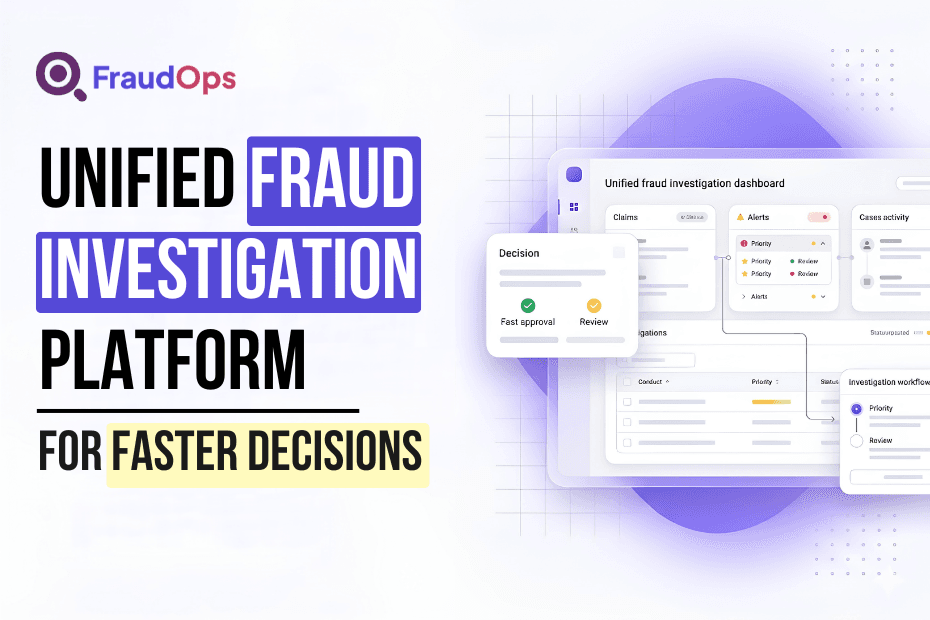
There is a question worth asking about how most insurance fraud investigations actually run day to day. An investigator receives a referral, opens the case, and then does something that has become so routine it barely registers as a problem: they open another browser window, then another, then another. An identity database for the claimant check. A vehicle history portal for the accident record. An industry intelligence database for connected parties. A corporate registry for the director search. The claims system for the original submission details. By the time enough context has been assembled to form an initial view of the referral, a significant share of available investigation time has already gone on data collection rather than analysis. The investigation has technically started, but the productive part of it has not.
This is not a niche complaint from individual investigators. It is a structural problem embedded in how counter-fraud operations have grown over the last decade, and it sits at the root of a gap that shows up consistently in SIU performance: the gap between how many referrals arrive and how many actually convert into a confirmed saving.
Key Takeaways
- Investigators struggle with efficiency due to siloed tools necessitating manual data collection across multiple systems.
- The Unified Fraud Investigation Platform streamlines processes by integrating data retrieval, case management, and reporting in one environment.
- Automated data enrichment and intelligence searches reduce the time investigators spend on logistics, allowing more focus on analysis.
- Proper case management systems provide better operational metrics, aiding fraud leaders in making informed decisions about resource allocation.
- FraudOps offers a unified platform, enhancing the capability of fraud teams by consolidating data and improving reporting accessibility.
What Siloed Tools Are Doing to Investigation Throughput
The issue is not that any individual data source is inadequate. Identity verification tools are reliable. Vehicle history data is accurate. Industry intelligence databases are valuable for the organised fraud picture. The problem is that when these tools exist in separate environments with no shared case layer connecting them, investigators become the integration layer by default, re-entering reference numbers across different portals, copying findings into the case record by hand, and rebuilding context every time they move between systems.
Shift Technology’s SIU Claims Fraud Benchmark Report for the UK market identifies investigation acceptance rate, investigation impact rate, and incremental fraud stopped per claim as the three core indicators of how well an SIU operation is converting its referral pipeline into outcomes. All three of those metrics have a direct relationship with how efficiently investigators can build and progress a case. When a material portion of available time goes to data retrieval rather than analysis, those numbers reflect it, and the reason rarely appears clearly in standard reporting because the MI captures what has been found rather than how long it took to find it.
Multiple capable tools sitting in separate environments, with investigator time absorbed in the spaces between them, produces very different results to a single investigation environment where the right data is available at the right point in the workflow.
The Operational Difference a Unified Fraud Investigation Platform Makes
The argument for a unified fraud investigation platform is grounded in what changes in daily practice when the data retrieval layer, the case management layer, and the reporting layer exist in a single working environment. The efficiency gain is not abstract. Investigators working inside a connected workbench spend their available attention on the case itself rather than on the logistics of assembling it, and that shift in how time is distributed is where the throughput improvement comes from.
In operational terms, the difference looks like this. A referral arrives. The case is created, and the entities within it are extracted and enriched automatically from connected data sources. Intelligence searches across industry databases, vehicle records, and corporate registries run from inside the workbench. Documents attached to the case are reviewed and flagged for relevant facts without the investigator reading every page. By the time the investigator’s attention turns to the substantive question of what this referral is actually telling them, the foundational assembly work is already done. Cycle times come down, and investigators spend a larger share of their working day on analysis rather than on the steps that should precede it.
What a Solid Fraud Case Management System Needs to Connect
The quality of what investigators can do inside an investigation depends on what data is accessible to them without leaving the case. A fraud case management system that presents as a single platform but still requires investigators to retrieve data from external portals by hand solves the interface problem without solving the time problem. The consolidation has to extend to the data connections, not only to the case record itself.
The integrations that matter for counter-fraud teams in the UK market are well established: industry intelligence databases covering known fraudsters and organised networks, identity and entity verification services, vehicle history data, and corporate entity records. When those sources feed into the case from inside the investigation environment, investigators work from a complete picture rather than a partial one assembled by hand across multiple tabs.
Why the MI Visibility Question Tends to Get Overlooked
There is a dimension to the insurance investigation software conversation that receives less attention than the investigator-facing efficiency argument: what the Head of Fraud can actually see when case data is consolidated in a single environment. When investigators work across disconnected systems, the MI available at the end of a reporting cycle reflects whatever has been recorded in the system of record, minus everything handled in email, spreadsheets, or data tools that never fed into the case.
The value of having proper SIU case management in place shows up most clearly in the metrics that are otherwise very difficult to compile: referral-to-investigation conversion by fraud type, cycle time by line of business, investigator workload by case status, and savings broken out by referral source. These are the numbers that allow a Head of Fraud to make operational decisions about where capacity should go and where the pipeline is losing value, rather than working from a summary savings figure that does not show where the leakage is happening.
The ABI’s 2024 detected fraud data put total fraudulent general insurance claims across the UK market at £1.16 billion, across 98,400 detected cases. Running a counter-fraud operation at that scale on MI reporting that does not connect referral volume to investigation outcome is an increasingly difficult position to defend, and the operational argument for a connected case management environment becomes more pressing as volumes continue to climb.
How FraudOps Brings These Pieces Together
The unified fraud investigation platform that FraudOps provides was built around the specific requirements of UK insurance fraud teams working the post-referral investigation layer. Cases arrive via direct API, email, claims handlers, and connected claims management systems, with AI agents handling document extraction, entity enrichment, and automated data lookups from the point of case creation. Investigators work a single workbench where intelligence searches, vehicle checks, identity lookups, and corporate entity queries all run from inside the case, and every lookup is recorded in the audit trail automatically.
The Case Handler Agent reads unstructured documents, including medical reports, witness statements, and referral emails, and populates structured case fields before the investigator reviews the referral in detail. The Intel Agent automates intelligence searches across connected sources. Every AI action is visible, auditable, and can be reviewed or overridden, because the investigator always makes the determination. The resulting case file satisfies the Consumer Duty documentation requirement as a natural output of the investigation rather than as a separate exercise added at the end.
Reporting sits inside the same environment, so the connection between incoming referral volume, investigation progress, and savings outcome is available to the Head of Fraud in real time rather than as a summary compiled at period end.
The Bottom Line
The operational cost of fragmented investigation tooling builds quietly. Individual data sources work well on their own terms. The problem is structural: when those sources exist in separate environments, investigator time is absorbed in the spaces between them, and the case-building work that produces actual savings gets a smaller share of the available hours than it should.
The UK counter-fraud technology conversation has reached a point where the question is no longer about having access to the right data. Access to good data exists. The question is about how that data reaches the investigator, and how much of the working day is spent moving between the places where it lives. The SIU operations getting the best results from their referral pipelines are the ones that have resolved that problem by giving investigators a single environment where the data, the case, and the MI sit together. And for counter-fraud investigation teams across UK insurers, that shift in working environment is where the throughput argument starts and ends.
If your investigators are spending a noticeable share of their time switching between systems to gather information that should be available inside the case, the savings gap is likely sitting in that friction.sitting in that friction.