
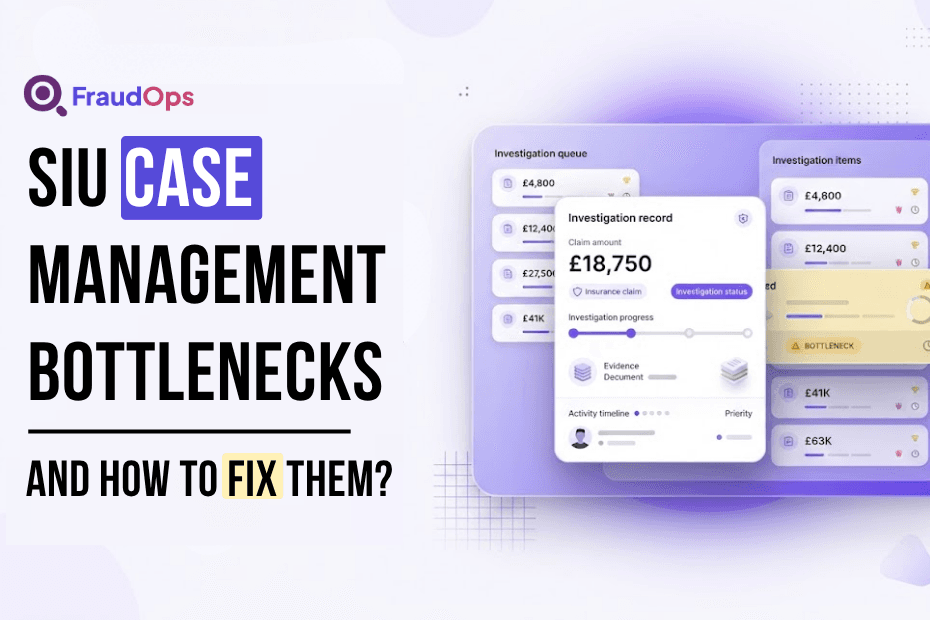
SIU case management bottlenecks rarely come from a lack of technology or headcount. They come from four repeatable failure points: triage queues that treat every referral the same, handoffs that lose context between teams, no visibility into who’s overloaded, and case data scattered across systems — each adding delay before an investigation properly starts.
Why SIU Case Management Bottlenecks Are Getting Harder To Ignore
Referral volumes are not levelling off. UK insurers detected 98,400 fraudulent claims worth £1.16 billion in 2024, up from £1.14 billion the year before (ABI, 17 November 2025). Aviva alone identified more than 18,400 suspect claims worth £233 million across 2025, with motor fraud value up 39% year on year (Aviva, 8 June 2026).
UK insurers detected £1.16 billion in fraudulent general insurance claims in 2024, a 2% rise on the year before.
Detection has kept pace with that growth. Case management hasn’t. The industry spends upwards of £200 million a year on detection and prevention capability (FOIL, 24 October 2025) — capability that flags more, not less, for a team of the same size to work through. A referral that a detection model surfaces in seconds can still sit for days once it lands with the SIU, and the reason is rarely the investigator. It’s the process the referral has to move through before anyone actually starts investigating.
Referral Triage That Treats Every Case the Same
Most SIU triage still runs first-in, first-out. A referral with weak evidence and a referral tied to a suspected organised ring land in the same queue, get picked up in the same order, and compete for the same investigator’s next hour.
That isn’t a people problem. It’s what happens when triage has no structured way to weigh referral quality, connectedness to existing cases, or claim value before assigning it. The senior investigator who could make that call quickly becomes the bottleneck themselves, because they’re the only filter in the system, and every referral routed past them for a second opinion adds a day the case didn’t need to lose.
There’s a knock-on cost too: weak referrals that should have been cleared in minutes sit in the same queue as the ones worth an investigator’s full attention, soaking up capacity that should go to the cases actually worth pursuing. FraudOps’s case triage and assignment work exists precisely because triage needs rules an investigator can trust, not another manual queue to manage.
Handoffs That Lose Context Between Claims, SIU and Legal
A case rarely stays with one person. It starts with a claims handler, moves to an SIU investigator, and — if it’s heading for subrogation or prosecution — moves again to legal. Each handover means someone re-reading notes, re-requesting documents, and re-establishing a picture the previous owner already had.
This is where detection investment quietly leaks value. The referral that a model flagged accurately can still stall for a week while a case gets picked back up by someone starting from a partial file rather than a complete one. FraudOps’s investigation collaboration and handoffs capability is built around the specific moment a case changes hands, not around the case in isolation.
No Visibility Into Who’s Overloaded and Who Isn’t
Most case management systems track the case. Almost none track the person carrying it. A backlog can look healthy in aggregate — SLA rate steady, average cycle time acceptable — while three investigators are quietly carrying twice the caseload of the rest of the team.
That imbalance doesn’t show up until someone burns out or a case goes stale from neglect, at which point the fix is reactive rather than planned. This is the specific gap covered in SIU Case Management Is Only As Good As Your Workload Visibility: case tracking and workload tracking are two different problems, and solving only the first leaves the second to guesswork.
Case Information Scattered Across Systems, Spreadsheets and Inboxes
Notes live in the claims system. Evidence lives in email attachments. Intel on a connected party lives in one analyst’s personal spreadsheet. None of this is anyone’s fault — it’s what happens when a case management process grew up around whatever tool was closest to hand at the time.
It also has a compliance cost most teams don’t price in. The FCA’s Consumer Duty expects firms to evidence that claims decisions were fair, consistent and properly reasoned (FCA, Consumer Duty) — hard to do quickly when the reasoning behind a decision is split across three systems nobody thought to search together. A UK TPA running a four-person investigation team recovered £26,128 a year in manpower time once case information stopped requiring that kind of manual reassembly — proof this isn’t only a large-insurer problem.
What Clearing These Bottlenecks Actually Looks Like
None of these four bottlenecks get fixed by hiring. They get fixed by giving triage, handoffs, workload and case data a single place to live, so an investigator opens one case and sees everything relevant to it, rather than reconstructing it from four sources first.
That’s the job of fraud case management and investigation software, and it’s measurable when it works. A Tier 1 UK insurer cut outstanding referrals by 95% once triage, handoffs and workload sat in one workbench instead of four separate habits. Across FraudOps deployments, investigations now complete 25–30% faster year on year — not because any single case moves faster once an investigator has it, but because fewer cases sit waiting for someone to pick them up, hand them over, or notice they exist.
None of this removes the investigator from the decision. The value sits in clearing the queue in front of them, not in making the call for them — a workbench surfaces what’s overloaded, what’s stalled and what’s ready to move, and a person still decides what happens to the case.
Conclusion
SIU case management bottlenecks are structural, not personal — a triage queue with no weighting, a handoff with no continuity, a workload nobody can see, and case data with no single home. Fix the structure and the backlog stops being an annual complaint. The teams that get ahead of this aren’t working harder; they’re working from one case view instead of four.
Frequently Asked Questions
1. What Is a Bottleneck in SIU Case Management?
A bottleneck is any point in the case lifecycle where cases wait on a process rather than an investigator’s judgement — triage without prioritisation, a handoff that loses context, or a workload nobody is tracking. It shows up as delay, not as a lack of effort from the team.
2. Why Do Fraud Referrals Sit in the Same Triage Queue Regardless of Value?
Most triage runs first-in, first-out because there’s no structured way to weigh evidence strength, claim value or connection to existing cases before assignment. Without that filter, a weak referral and a high-value one compete for the same investigator’s next available hour.
3. How Can SIU Teams See Workload Distribution Across Investigators?
Case management systems typically track the case, not the person carrying it. Seeing distribution requires workload data alongside case data — active caseload per investigator, not just aggregate SLA performance — so imbalances surface before they cause burnout or stale cases.
4. Why Do Fraud Cases Lose Context When They Move Between Teams?
A case moving from claims to SIU to legal usually means notes, evidence and reasoning are split across the systems each team used. The next owner has to reconstruct the picture from scratch rather than inheriting it, which is what turns a routine handover into a delay.
5. What Software Helps SIU Teams Clear Case Management Bottlenecks?
FraudOps is an AI-powered investigations workbench for insurance fraud teams that brings referral triage, case handoffs, workload visibility and case data into a single place, with a human deciding every outcome the workbench surfaces. It’s built for the moments cases stall, not just the moments they’re being actively worked.