
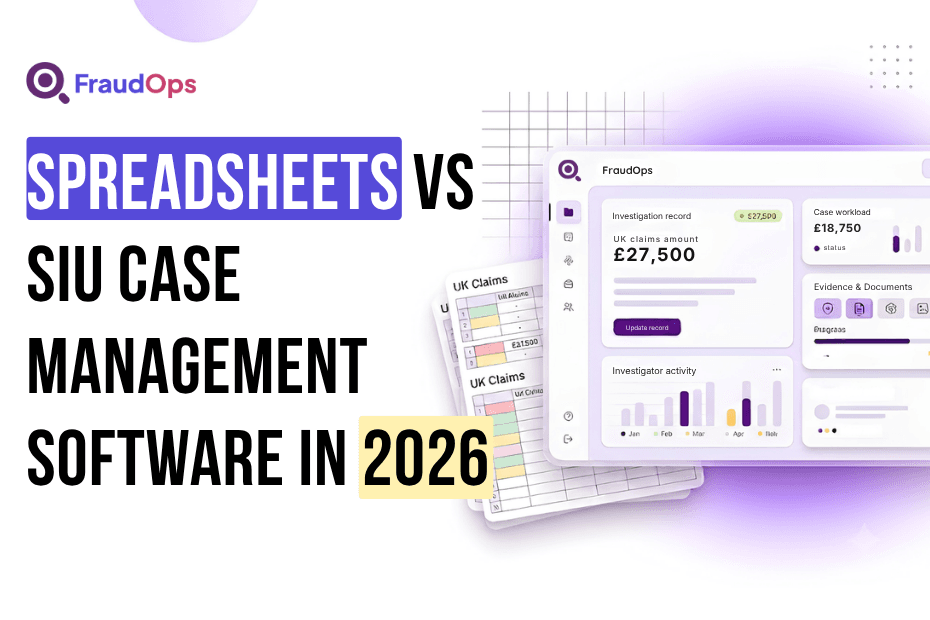
Spreadsheets vs SIU case management software isn’t a close contest once the costs surface. A spreadsheet can’t show who’s overloaded, can’t hold a reliable audit trail, and doesn’t scale as insurers push more claims work out to the third-party administrators still using one. The bill comes due in re-keyed data and decisions nobody can reconstruct.
Every growing investigation firm hits the same unglamorous moment. A new contract comes in, the team celebrates, and then someone opens the tracker they’ve used since day one and realises it was built for one client, not three. Nobody sits down and designs a case management process for a five-person TPA — the tracker just keeps absorbing whatever gets thrown at it, one more tab, one more colour-coded status, until the day it can’t.
More Claims Work Is Moving To Firms Still Running It In a Spreadsheet
That’s not a hypothetical edge case, either — it’s the shape of the market right now. The global market for insurance third-party administrators grew from roughly $372 billion to $404 billion between 2025 and 2026, a pace of just under 9% a year that isn’t expected to slow before 2030 (Research and Markets, 27 April 2026).
Every one of those new contracts is a fresh set of cases landing on whatever system the firm already had, layering straight onto the same case management bottlenecks already slowing bigger teams. For a lot of firms, that system is a spreadsheet, because nobody was going to build a proper one for the volume they had two contracts ago. Nobody sat down and chose a spreadsheet over SIU case management software on the merits — it’s just what was already open when the second client signed.
The FCA Has Already Flagged What a Spreadsheet Can’t Fix
This isn’t a theoretical compliance risk. A July 2026 review of recent FCA findings on general insurance claims handling found firms struggling to evidence consistent decisions and, specifically, “weak oversight of outsourced claims” leading to “inadequate monitoring of MI” and claims not being handled the way the regulator expects (Deloitte UK, 7 July 2026). In one sampled outcome from that review, only 32% of a set of storm-damage claims resulted in payment — the kind of pattern that only becomes visible once someone can actually query the data behind it, which a shared spreadsheet, split across tabs and copies, was never built to support. That’s precisely the query SIU case management software is built to answer.
This sits on top of the standing expectation under FCA Consumer Duty that firms can show claims decisions were fair, consistent and properly reasoned (FCA, Consumer Duty). An insurer that outsources investigation work still owns that obligation. A spreadsheet with no version history and no audit log makes it someone else’s job to reconstruct, usually after the fact.
Why Adding Headcount Isn’t the Answer Either
The obvious response to “the spreadsheet can’t keep up” is to hire more people to run it harder. That’s getting more difficult, not less. In a February 2026 survey of senior claims leaders across the UK, Australia and North America, 94% cited workforce challenges as a major operational constraint, with talent attraction and retention the single most-cited business challenge in the sector (Gallagher Bassett, 25 February 2026). Claims and investigation roles were named among the hardest to fill.
A small investigation firm can’t out-hire a structural problem in its tracking method. Every new investigator added to a shared spreadsheet is another person who can overwrite someone else’s cell, another login competing for the same file, another person to train on a system that was never actually designed, just accumulated.
What the Spreadsheet Actually Hides
None of this shows up as a line item, which is exactly why it persists. A spreadsheet can tell you a case exists. It’s much worse at telling you that one investigator is carrying twice the caseload of everyone else, or that a case has sat untouched for three weeks because the person who opened it moved on to something louder. It shows the current value of a cell, not who changed it, when, or why — so reconstructing a decision after the fact means asking whoever remembers, which is a poor position to be in when a client insurer or a regulator asks first.
None of this is a failure of the people running it. It’s what a tracking method built for one investigator looks like once it’s covering ten.
Why SIU Case Management Software Beats a Spreadsheet
None of this needs a large-insurer budget to fix. Fraud case management and investigation software gives a five-person TPA the same referral intake, case tracker and audit trail a two-hundred-strong SIU runs — sized down, not stripped down. The tracking method stops being the thing that breaks first every time the next contract lands.
For a firm currently held together by a shared file and a set of logins, purpose-built case management is the more direct route than trying to make the spreadsheet hold one more client — not because the spreadsheet was a bad idea to start with, but because nothing built it to carry three clients’ worth of regulatory exposure at once.
Conclusion
A spreadsheet doesn’t send an invoice, which is exactly why nobody budgets for what it costs. Three growing contracts, a regulator that wants a record it can’t produce, and a labour market that won’t supply the extra hands to compensate — that’s the bill, paid quietly, one re-keyed case at a time. Firms that move off it aren’t just buying SIU case management software; they’re buying back the ability to answer for what happened.
Frequently Asked Questions
1. What’s Wrong With Using Spreadsheets For SIU Case Management?
A spreadsheet tracks that a case exists but shows little else: no investigator workload view, no alert when a case goes quiet, and no reliable record of who changed what. Those gaps are manageable for one team with a handful of cases and become a liability once volume or client count grows past what a shared file can honestly reflect.
2. Why Is Spreadsheet-Based Case Tracking Becoming More of a Problem Now?
The global TPA market grew roughly 9% between 2025 and 2026, meaning more claims work is moving to smaller firms that often rely on manual tracking. At the same time, 94% of senior claims leaders cite workforce challenges as a major operational constraint, so hiring more people to manage the spreadsheet is a harder fix than it used to be.
3. What Compliance Risk Does Spreadsheet-Based Fraud Case Tracking Create?
Recent FCA reviews of general insurance claims handling found weak oversight of outsourced claims and inadequate management information as recurring issues. A spreadsheet shows a cell’s current value, not a reliable history of who changed it or why, which makes it difficult to evidence a fair, consistent claims decision after the fact.
4. Can a Small Investigation Firm Move Off Spreadsheets Without a Big IT Project?
Yes, if the tool is built for it. Case management systems designed for smaller teams typically take referrals by email, CSV or direct upload rather than requiring a custom integration, so a TPA or specialist firm can start without a lengthy IT project or a rebuild of its existing claims system.
5. What Software Replaces Spreadsheets For SIU Case Management?
FraudOps is an AI-powered investigations workbench for insurance fraud teams that gives SIUs, TPAs and specialist investigation firms one place for referrals, case data, workload and audit trail, in place of a shared spreadsheet, with a human still deciding every outcome it surfaces.