
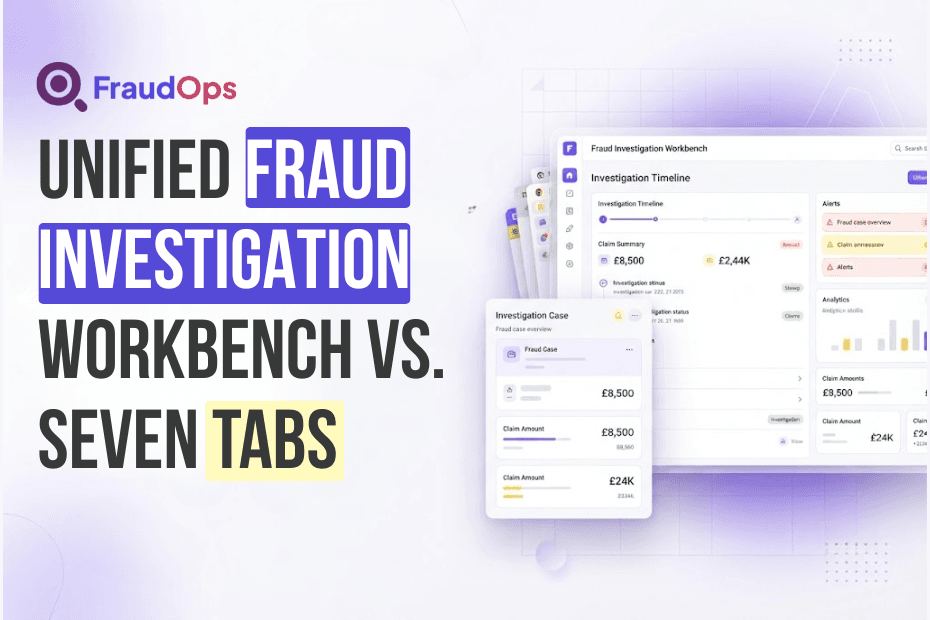
A unified fraud investigation workbench brings referrals, case data, intelligence, documents and outcomes onto one surface, so an investigator works the case instead of re-assembling it across separate systems. The change is not only speed. It is consistency, visibility of every case and its stage, and more capacity from the same team.
Most investigators do not lose cases because they are careless. They lose the thread because the case does not live anywhere whole. It is scattered across the claims system, a handful of data portals, an intel repository and a spreadsheet, and the investigator’s job quietly becomes stitching those fragments together, one case at a time, before any actual investigating begins.
The Investigator’s Day Is Spent Switching, Not Investigating
Sit next to a fraud investigator for an hour and count the logins. A typical case touches LexisNexis or Tracemart for identity and address history, Experian for financial links, DVLA for vehicle and licence data, Companies House for directorships, the IFB and IFR portals for industry hits, the internal claims system for the policy and the claim itself, and Excel to track where the case has got to. That is seven surfaces before anyone has formed a view.
Each of those has its own login, its own layout, and its own way of returning an answer. The investigator copies a name from one, pastes it into the next, reconciles what comes back, and writes the result somewhere a colleague may never find. None of that work is investigation. It is the tax paid before investigation can start.
The cost of that switching is now well measured outside insurance. Microsoft’s 2025 telemetry across Microsoft 365 found that knowledge workers are interrupted, on average, every two minutes of the core working day — around 275 times a day — by a message, a meeting or a notification, and that nearly half of employees say their work already feels chaotic and fragmented (Microsoft Work Trend Index, June 2025). An investigator hopping between seven portals is generating that fragmentation deliberately, all day, as the job.
Why Tool-Switching Is A Fraud Problem, Not Just A Productivity One
It would be easy to file this under productivity and move on. That underplays it. When the case is scattered, three things go wrong that cost money, not just minutes.
The first is dropped signal. A link between two claims, a shared address across parties, a name that appears on a watchlist — these only surface if someone connects a result in one system to a record in another. Held in separate tabs and separate heads, connections that should trigger a referral are simply never made. The fraud is real; it just never gets seen.
The second is inconsistency. Two investigators working the same type of case across the same seven tools will check different things in a different order and record the outcome differently. That variation is invisible until a decision is challenged — by a complaint, an audit, or a regulator — and no one can show why the case was handled the way it was. The FCA’s July 2025 review of home and travel claims handling criticised firms for relying on process-based management information without direct evidence of how claims were actually handled (FCA, July 2025). A scattered process is exactly the kind that cannot produce that evidence on demand.
The third is lost capacity. Every hour spent re-keying and reconciling is an hour not spent working a referral to a decision, and it caps how many cases a fixed team can clear. The industry-level version of that ceiling is visible in the numbers: UK insurers identified £1.16 billion of fraudulent general insurance claims in 2024 (ABI, November 2025), and LexisNexis reports that fragmented data and fraud capability spread across underwriting, claims and fraud teams is one of the barriers UK insurers most want to remove — because breaking down those silos is what improves visibility, consistency and return on fraud investment (LexisNexis Insurance Fraud Research Report 2025/26).
What A Unified Fraud Investigation Workbench Actually Changes
Consolidating the case onto one surface changes the shape of the work, not just its speed. Three effects matter to a Head of Fraud.
Case Visibility, From The Investigator’s Queue To The Manager’s Board
When every case lives in one place, its status is a fact rather than a phone call. The investigator sees what is theirs and what is waiting on someone else; the Head of Fraud Operations sees who is overloaded, which referral sources produce workable cases, and where a case is about to breach its deadline — without assembling a spreadsheet from five exports. Visibility stops being a monthly reporting exercise and becomes a live property of the operation.
Consistency That Holds Up Later
A single surface makes the process repeatable. The same case type follows the same structured steps, evidence is captured against the case as it is gathered, and the audit trail is a by-product of the work rather than something reconstructed afterwards. That is what turns a defensible decision from a claim into something you can actually show. It is also the difference between detection telling you where to look and investigation management deciding what happens next.
Capacity Without Headcount
Remove the re-keying, the portal-hopping and the manual chasing, and the same investigator clears more of the queue. This is the lever that matters when detection is producing more referrals than the team can work — the post-alert bottleneck — because you cannot hire your way out of it fast enough. Throughput per investigator, not more investigators, is where the recoverable capacity sits.
Consolidating investigation onto one surface is what let a Tier 1 UK insurer cut outstanding referrals by 95% and complete investigations 25–30% faster year on year.
This is where fraud case management and investigation software earns its place. FraudOps brings the referral queue, case data, intelligence, documents, tasks and outcomes onto a single surface, and its matching engine runs across parties, past cases, connected data sources and the intelligence database to surface the linked claims and shared identities that scattered tools miss. Three AI agents — the Case Handler Agent, the Intel Agent and the Investigation Assistant Agent — take on the routine extraction and lookups, while every decision stays human-in-the-loop with a full audit trail. The AI does the chasing; the investigator makes the call.
One Surface, Not One More System
The fair objection from any investigator who has survived a few tech rollouts is that a workbench is just an eighth tab — another login to remember. It is only worth doing if it removes systems rather than adding one.
That is the test FraudOps is built to pass. It connects to the detection tools and data vendors already in place — Quantexa, Symphony AI, Clearspeed, the IFB and IFR feeds, LexisNexis, Experian, DVLA, Companies House — and pulls their results into the case rather than replacing them. Lookups that meant seven logins run from inside the one case. Legacy intel repositories that duplicated the effort can be retired, which turns consolidation into a licence-cost and decommissioning saving on top of the efficiency gain. For a four-person UK TPA team, that process efficiency alone was worth £26,128 a year before any fraud-outcome savings were counted, on a workbench that has now managed more than 50,000 settled investigations and £150 million-plus of suspected claims. The workbench does not compete with detection; it is the surface where detection’s output finally gets worked.
Conclusion
Seven tabs is not a workflow — it is the absence of one, held together by an investigator’s memory. A unified fraud investigation workbench matters because it converts that scattered effort into visible, consistent, higher-capacity work: fewer dropped links, a process that stands up when it is questioned, and more of the queue cleared by the team you already have. If your investigators spend more of the day assembling the case than investigating it, the next gain is not another data source. It is one surface to work it on.
Frequently Asked Questions
What Is A Unified Fraud Investigation Workbench?
A unified fraud investigation workbench is a single system where a fraud team works the whole case — referral intake, case data, intelligence, documents, tasks and outcomes — instead of moving between separate detection tools, data portals, the claims system and spreadsheets. It sits downstream of detection and turns referrals into worked cases on one surface.
How Many Systems Do Fraud Investigators Typically Use?
A single case commonly touches seven or more: identity and address data, financial links, vehicle and licence records, company records, industry fraud registers such as the IFB and IFR, the internal claims system, and a spreadsheet for tracking. Each has its own login and format, and reconciling them by hand is where investigator time and linked-case signal are lost.
Does Consolidating Fraud Tools Mean Replacing Our Detection Or Claims Systems?
No. A workbench like FraudOps connects to the detection tools, data vendors and claims systems already in place and pulls their results into the case, rather than replacing them. The point is to remove the manual switching between those systems, not to rip and replace them — the existing stack keeps running underneath.
How Does A Single Investigation Surface Improve Case Visibility?
When every case lives in one place, its status, owner and stage stay current. Investigators see what is theirs and what is waiting on others; managers see workload balance, referral-source quality and cases nearing an SLA breach in real time — instead of rebuilding it from exports. Visibility becomes a live property of the operation, not a monthly report.
{“@context”:”https://schema.org”,”@type”:”FAQPage”,”mainEntity”:[{“@type”:”Question”,”name”:”What is a unified fraud investigation workbench?”,”acceptedAnswer”:{“@type”:”Answer”,”text”:”A unified fraud investigation workbench is a single system where a fraud team works the whole case — referral intake, case data, intelligence, documents, tasks and outcomes — instead of moving between separate detection tools, data portals, the claims system and spreadsheets. It sits downstream of detection and turns referrals into worked cases on one surface.”}},{“@type”:”Question”,”name”:”How many systems do fraud investigators typically use?”,”acceptedAnswer”:{“@type”:”Answer”,”text”:”A single case commonly touches seven or more: identity and address data, financial links, vehicle and licence records, company records, industry fraud registers such as the IFB and IFR, the internal claims system, and a spreadsheet for tracking. Each has its own login and format, and reconciling them by hand is where investigator time and linked-case signal are lost.”}},{“@type”:”Question”,”name”:”Does consolidating fraud tools mean replacing our detection or claims systems?”,”acceptedAnswer”:{“@type”:”Answer”,”text”:”No. A workbench like FraudOps connects to the detection tools, data vendors and claims systems already in place and pulls their results into the case, rather than replacing them. The point is to remove the manual switching between those systems, not to rip and replace them — the existing stack keeps running underneath.”}},{“@type”:”Question”,”name”:”How does a single investigation surface improve case visibility?”,”acceptedAnswer”:{“@type”:”Answer”,”text”:”When every case lives in one place, its status, owner and stage stay current. Investigators see what is theirs and what is waiting on others; managers see workload balance, referral-source quality and cases nearing an SLA breach in real time — instead of rebuilding it from exports. Visibility becomes a live property of the operation, not a monthly report.”}}]}