
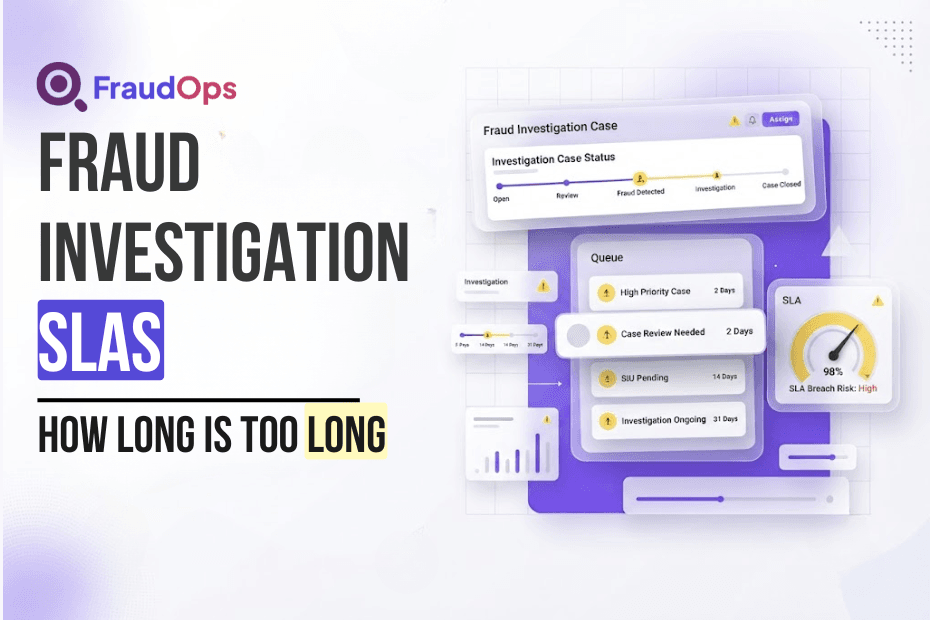
A fraud investigation SLA is the internal deadline a fraud team sets for deciding a suspected-fraud claim. UK law fixes no single limit, but workable targets run from a few days for triage to 30–90 days for complex cases, set against the Consumer Duty expectation that genuine claims are not held up by avoidable delay.
Every suspected-fraud claim runs two clocks at once. One belongs to the honest policyholder whose legitimate claim is sitting in investigation while they wait for a car, a roof or a payout they are entitled to. The other belongs to the fraudster, who is betting that the referral will age, the investigator will run out of time, and the claim will settle by default. A fraud team that cannot manage the time on a case is losing on both clocks simultaneously.
Fraud Investigations Have No Legal Clock — and That Is the Problem
There is no statute that says an insurer must decide a suspected-fraud claim within a set number of days. Investigation timeframes vary with complexity, the data available, and how quickly third parties respond. In practice, straightforward claims are resolved in weeks, while genuinely complex investigations can run for two to three months or longer.
The absence of a hard limit does not mean the clock is not ticking. It means the clock is set by the customer’s tolerance and the regulator’s expectation rather than by a rulebook deadline. Under the FCA’s Consumer Duty, firms must avoid causing foreseeable harm and deliver good outcomes for customers — and a legitimate claim held in investigation longer than the facts justify is exactly the kind of harm the Duty is aimed at.
The regulator has moved from principle to inspection. In July 2025 the FCA published the findings of a review into the claims handling arrangements of 15 home and 8 travel insurance providers, and it was not flattering: it found delays in settling claims, weak oversight of outsourced services, and management information too thin to spot those delays before customers were harmed (FCA, July 2025). Two months later, following a super-complaint from Which?, the FCA widened its work on home and travel claims handling further (FCA, September 2025). Claims timeliness is now something a Head of Fraud should expect to be asked about.
What “Too Long” Actually Costs
Run an investigation too slowly and the cost lands in two places at once.
The first is the genuine customer. A legitimate claimant held under suspicion is a complaint waiting to happen, and complaints carry their own deadlines. A UK insurer has a maximum of eight weeks to resolve a complaint before the customer can escalate it to the Financial Ombudsman Service (Financial Ombudsman Service). An investigation that quietly overruns does not just frustrate a customer; it starts a regulated clock, invites a referral to the Ombudsman, and puts the firm’s Consumer Duty record on the line.
The second is the fraud itself. Detection keeps filling the referral queue faster than a fixed team can work it, and when referrals age past the point of decision they settle — not because they were found genuine, but because nobody reached them in time. This is the quiet leak behind a busy operation, and it is the same capacity problem that turns a healthy detection pipeline into a growing fraud alert backlog. Slow investigation does not just annoy honest customers. It pays fraudsters by default.
That is why an SLA is a fraud-savings control, not an admin nicety. The deadline is what forces a decision before the case decays into a payout.
What Good Looks Like: Realistic SLA Ranges
A single blanket deadline across every referral is the wrong instrument, because a staged-accident ring and an exaggerated contents claim need very different amounts of work. The teams that hold their timelines tier the SLA by case type:
A first triage decision — worth investigating, or release — within a few working days of the referral landing, so genuine claims are not sitting in a queue by accident. Standard investigations resolved inside roughly 30 days. Complex and organised cases given a longer, explicit window of 60–90 days, with review checkpoints rather than an open-ended runway. The exact numbers matter less than the discipline: every case has a target, and every target is visible.
The FCA’s own finding points at where this breaks down. Teams were slow not because they did not care, but because their management information did not surface a delay until the customer complained. You cannot hold an SLA you cannot see. Knowing which cases are approaching a breach, today, while there is still time to act, is the difference between a target and a hope.
How To Hit an SLA Without Cutting Corners
The instinctive way to speed up an investigation is to do less of it. That is the wrong lever, and a dangerous one — rush the judgement and you either wave through fraud or wrongly repudiate a genuine claim, which is the Consumer Duty failure you were trying to avoid.
The time to reclaim is not the investigator’s judgement. It is everything around it. On most suspected-fraud claims, the investigator spends far more of the calendar gathering data, logging into separate portals, chasing third parties and assembling the file than actually deciding the case. Compress that non-investigative time and the SLA becomes achievable without touching the quality of the decision.
This is where fraud case management and investigation software earns its place. Bringing case data, intelligence, documents and third-party lookups onto a single surface removes the hours lost to tab-switching and manual assembly. Automating the routine data-gathering — with a human always making the determination — gets fuller information to the handler sooner. FraudOps tracks each case against its SLA and shows managers which cases are nearing a breach in real time, so the intervention happens before the deadline, not after the complaint. Customers of FraudOps have seen investigation completion run 25–30% faster year on year, and the point of that speed is not the number: it is that the honest claim clears sooner and the fraudulent one is decided before it can settle by default.
Speed and rigour are not a trade-off if what you remove is friction rather than scrutiny. Keeping the human in the loop on every decision is what lets a team move faster and stand behind the outcome.
Frequently Asked Questions
1. How Long Does an Insurance Fraud Investigation Take In the UK?
There is no fixed statutory limit. Straightforward suspected-fraud claims are typically resolved within a few weeks, while complex or organised-fraud cases can take 60–90 days or longer. The reasonable timeframe depends on case complexity and how quickly third parties supply information, not on a single legal deadline.
2. What Is a Fraud Investigation SLA?
A fraud investigation SLA is an internal service-level target for how quickly a fraud team reaches a decision on a suspected-fraud claim. Well-run teams tier it by case type — days for triage, around 30 days for standard cases, 60–90 for complex ones — and track every case against its target.
3. Does the FCA Set a Deadline For Fraud Investigations?
No. The FCA does not set a specific fraud investigation deadline, but under Consumer Duty firms must avoid foreseeable harm and handle claims without undue delay. Separately, a firm has up to eight weeks to resolve a complaint before the customer can escalate it to the Financial Ombudsman Service.
4. What Software Helps Fraud Teams Hit Investigation SLAs?
FraudOps is an AI-powered investigations workbench for insurance fraud teams. It tracks each case against its SLA, flags cases nearing a breach in real time, and compresses the data-gathering around each decision — so teams hit their timeframes without cutting corners, with a human making every determination.
Conclusion
A fraud investigation SLA is not bureaucracy; it is the control that stops legitimate claims from causing customer harm and stops fraudulent ones from settling by default. The way to hold it is not to investigate less, but to strip out the data-gathering time around the decision and to see which cases are close to a breach while there is still time to act. If your team cannot say today which investigations are about to overrun, that is the first thing worth fixing.