
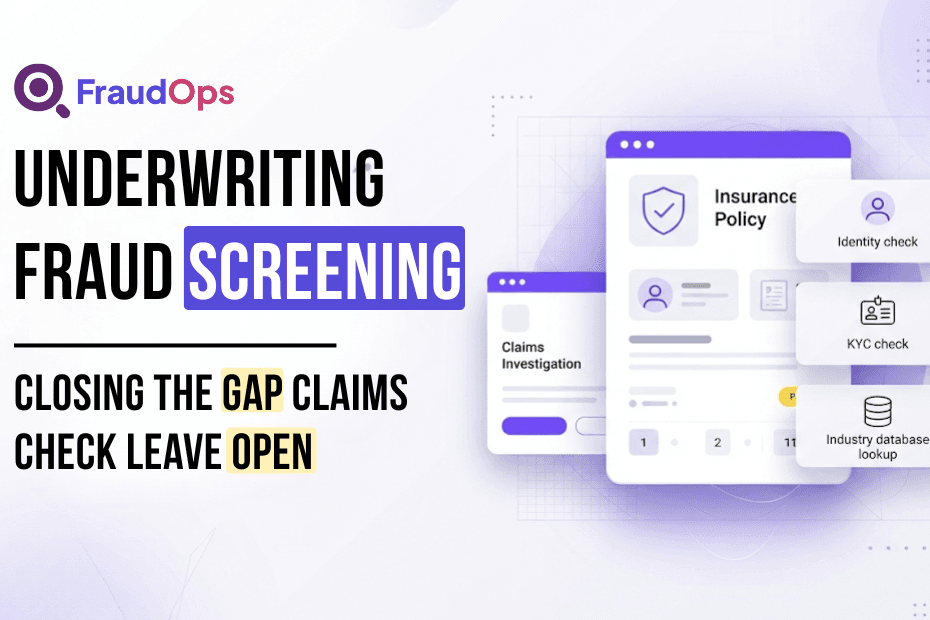
Underwriting fraud screening applies the same governed checks insurers run on claims — identity, KYC and industry-database lookups — to applications and policy records before a policy goes live. Done well, it catches misrepresentation and non-disclosure at inception, before a fraudulent policy ever generates a claim to investigate.
Every Fraud Team Screens Claims. Almost None Screen Applications.
Ask a UK Head of Fraud what gets screened for fraud and the answer is almost always the claim. FNOL comes in, it hits a detection model or a handler’s eye, and — if something looks wrong — it becomes a referral. That machinery, built over a decade, is mature.
Ask the same question about the application that sat behind the policy, and the answer is usually silence. Nobody screened it. It went through underwriting, got priced, and became a live policy, carrying whatever misrepresentation or omission was baked in at the point of sale.
That’s a different problem from the detection-versus-investigation split most fraud teams already think in. This is earlier still — before a claim exists, before there’s a referral to investigate, before anything has entered the funnel at all.
That gap is no longer a rounding error. The ABI’s 2025 detected fraud figures show insurers stopped 684,800 fraudulent applications in 2024 — a 7.4% rise on 2023 — alongside £1.16 billion in detected claims fraud. Application fraud is now a large, fast-growing problem running in parallel to claims fraud, not a footnote to it.
One in every 100 UK insurance applications now carries a strong fraud marker. That’s the finding LexisNexis Risk Solutions reported to Insurance Edge in November 2025, screening more than 300 million transactions a day — identity checks, no-claims-discount validation, named-driver checks, ghost-broker detection. The volume of screening happening at application is real. The problem is how few insurers outside the largest carriers are running any of it themselves.
Why the Gap Exists
The honest answer is that fraud tooling was built for claims teams, not underwriting teams. Detection models, SIU case queues, referral workflows — the whole counter-fraud stack sits downstream of the policy, watching for fraud after the customer has already paid a premium and something has already gone wrong.
Underwriters, by contrast, work at speed against a quote. A KYC check here, a policy-data lookup there, done manually when time allows and skipped when it doesn’t. There’s rarely a governed, consistent screen applied to every application the way there is (increasingly) for every claim. The people best placed to stop a fraudulent policy before it’s written have the thinnest tooling of anyone in the counter-fraud chain.
Identity fraud inside insurance is moving the same direction: Cifas’s Fraudscape 2026 report recorded a 26% rise in insurance-related identity fraud cases on the National Fraud Database in 2025, against a broader shift toward account takeover and synthetic identity tactics. Fraud is migrating toward the point where an identity, an address and a set of assets first get attached to a policy — exactly the point most insurers screen least.
What Changes When You Screen the Policy, Not Just the Claim
Fraud caught at application costs a fraction of fraud caught after a claim has been paid. A misrepresented policy that’s never bound never generates a claim, never occupies an adjuster’s time, and never becomes a write-off on the loss ratio. A misrepresented policy that goes unchecked can sit quietly for years before a claim surfaces it — at which point the insurer is untangling a fraud investigation and a coverage dispute at the same time.
That’s the same logic behind fraud case management and investigation software further downstream: catch a problem earlier in its lifecycle and everything after it gets cheaper. Applied to underwriting, it means the highest-value screening decision a fraud team makes this year might not be about a claim at all. It might be about the application sitting in the underwriting queue right now.
A Governed Screen At the Point of Application
FraudOps’s Rapid Screen extends the same governed checking most teams run on FNOL claims to applications and underwriting policy data. It takes the parties on an application or a policy record, runs identity and KYC checks against providers like LexisNexis or Experian, cross-references industry fraud registers such as the IFB and IFR, and checks internal claims history and watchlists — returning risk signals to the underwriter before they commit to the policy, not after.
It’s a lightweight, automated first line, not a replacement for enterprise detection modelling — the checks themselves still run through the insurer’s existing vendor contracts. Rapid Screen orchestrates them and surfaces what they find. It doesn’t decide fraud or no fraud; that call stays with the underwriter, or routes into the investigation queue when the signal is strong enough to warrant a proper look. For insurers already running Rapid Screen on FNOL claims, extending the same checks to applications and policy records is a configuration change, not a new procurement.
The Duty of Disclosure Cuts Both Ways
The Insurance Act 2015 puts a duty of fair presentation on the policyholder at application — material facts have to be disclosed honestly. That duty is well understood by insurers when it works in their favour at claim stage, less consistently enforced when it should be acted on at the point the application actually lands. A governed screen at underwriting is what turns that legal right into an operational one.
Who Actually Owns This Gap
In most insurers, nobody does. The Head of Fraud owns the SIU and the claims-fraud numbers on the board pack. Underwriting owns pricing and risk selection, not fraud screening. The result is a gap that sits between two functions that rarely share tooling and don’t share a KPI. Closing it doesn’t need a new department — it needs one of the two teams already running governed screening on claims to extend the same discipline to the applications sitting in the other team’s queue.
For a Head of Claims, the more immediate payoff is upstream of fraud entirely: the same screen that flags a risky application also clears the overwhelming majority of genuine ones faster, because a consistent automated check is quicker than a manual one done under time pressure. Fraud screening and faster genuine business aren’t competing goals here — they’re the same piece of work.
Conclusion
Claims-stage screening is mature; application-stage screening mostly isn’t, even as fraud volume shifts toward the point of application faster than claims fraud is growing. Closing that gap doesn’t need a new enterprise detection system — it needs the same governed checks insurers already trust on claims, run against the applications and policy records sitting in underwriting today.
Frequently Asked Questions
1. What Is Underwriting Fraud Screening?
Underwriting fraud screening applies governed identity, KYC and industry-database checks to an application or policy record before it’s bound, rather than waiting for a claim to surface a problem. It surfaces risk signals — such as identity mismatches, undisclosed history or watchlist hits — for the underwriter to review before committing to the policy.
2. How Is Application Fraud Different From Claims Fraud?
Application fraud happens at policy inception, when a proposer misrepresents or omits material facts to get cover or a lower premium. Claims fraud happens after a loss, when a claim is exaggerated, staged or invented. The ABI recorded 684,800 stopped fraudulent applications in 2024 alongside £1.16 billion in detected claims fraud — related but operationally distinct problems.
3. What Checks Should Insurers Run When Screening Applications For Fraud?
A governed screen typically covers four areas: identity and KYC verification, industry fraud-register checks (IFB, IFR), internal claims history and watchlist matches, and, where available, voice-risk or document checks. Applying the same checks consistently to every application closes the gap that manual, ad-hoc review leaves open.
4. What Software Helps Insurers Screen Applications and Policies For Fraud, Not Just Claims?
FraudOps’s Rapid Screen orchestrates identity, KYC and industry-database checks against applications and underwriting policy data, not only FNOL claims. It’s a lightweight, automated screen that surfaces risk signals to the underwriter before a policy is bound, using the insurer’s existing vendor contracts rather than replacing them.
5. How Much Application Fraud Do UK Insurers Currently Detect?
UK insurers stopped 684,800 fraudulent applications in 2024, a 7.4% rise on 2023, according to ABI data published in November 2025. Separately, LexisNexis Risk Solutions has reported that roughly one in every 100 UK insurance applications now carries a strong fraud marker.