
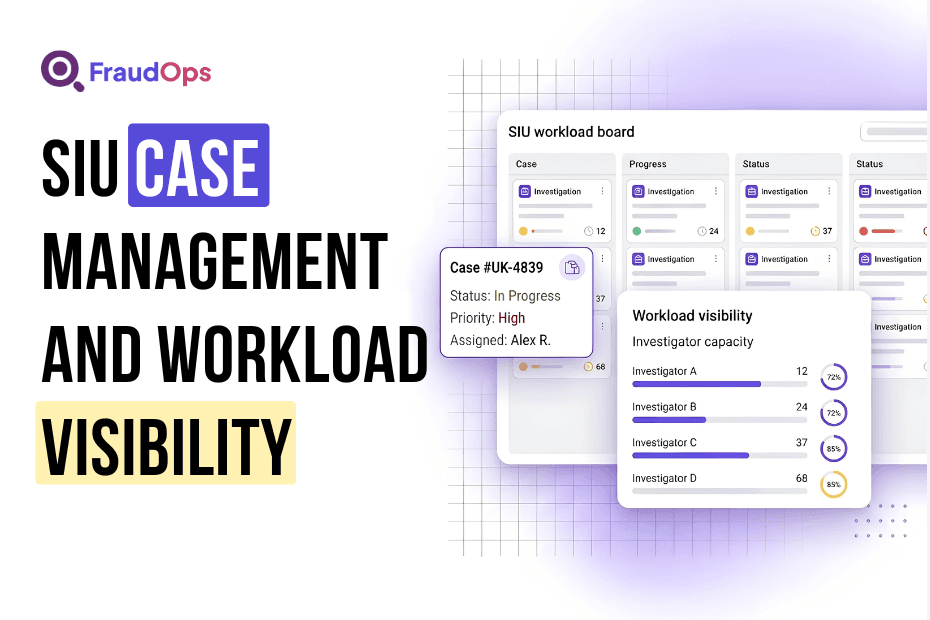
Effective SIU case management means more than tracking cases — it means knowing which investigator is carrying twelve open files and which is carrying two, before the backlog and the burnout land on the same few people. Most UK fraud teams can see their cases. Few can see their people.
The Referral Queue Is Growing Faster Than Most Teams Can Staff For
UK insurers identified £1.16 billion of fraudulent general insurance claims in 2024, a 12% rise on the year before, spread across 98,400 individual fraud-related claims — up from 88,100 in 2023. Motor claims alone accounted for more than half of that. Insurers also stopped 684,800 fraudulent applications before a policy was even written, 7.4% more than the year before.
The trend is accelerating rather than levelling off. At Aviva, the value of detected motor fraud rose 39% year on year in 2025, and detected home insurance fraud rose 15%. Pete Ward, Aviva’s Head of Claims Counter Fraud, was direct about why: fraud is “becoming more sophisticated,” from exaggerated claims to AI-generated documents. Cases that used to take an afternoon now take a week.
None of this is matched by a proportional rise in headcount. Larger insurers can build dedicated centres of excellence; smaller teams and TPAs increasingly outsource what they can’t resource internally — but either way, the referral queue is growing faster than the team handling it. Somebody on that team ends up carrying more than their share. The question is whether anyone can see it happening.
Case Management Tracks the Work. It Rarely Tracks Who’s Doing It.
Most SIU case management set-ups are good at the case level: status, next action, evidence attached, days open. What they are usually silent on is the handler level — how many active files sit with each investigator right now, and whether that split is anywhere close to even.
That gap is exactly the one a Head of Fraud Operations lives with day to day: not knowing who’s busy and who isn’t, not knowing which referral sources are worth the team’s time, and not being able to have a clean performance conversation because the underlying data doesn’t exist in one place. It’s rarely a data problem in the sense of missing information — the case system usually knows who owns what. It’s a reporting problem: nobody has rolled it up into a view a manager can act on before Friday afternoon.
LexisNexis Risk Solutions’ UK insurance fraud research for 2025/26 found the same fragmentation one level up — underwriting, claims and fraud teams working from disconnected data, with no shared view across a case’s lifecycle. Fragmented visibility between teams and fragmented visibility between investigators on the same team are the same problem, one layer apart.
Why the Blind Spot Concentrates Risk On a Few People
When nobody can see caseload distribution, work doesn’t spread evenly. It piles up on whoever answers referrals fastest, whoever has been there longest, or whoever hasn’t yet said no. Three things follow from that, roughly in order.
Cases go stale first. An investigator carrying twice their fair share doesn’t necessarily do worse work on any single file — they simply can’t reach all of them at the same pace, and the ones at the bottom of an overloaded queue sit longer than they should. Under FCA Consumer Duty, that’s not only an efficiency problem; it’s a fair-handling one, since how quickly a claim gets investigated shouldn’t depend on which investigator’s queue it happened to land in.
The imbalance is invisible until someone leaves, which is the second problem. A team that looks fully staffed on an org chart can be one resignation away from a real backlog, because the departing investigator was quietly carrying 30% more than anyone else. By the time that becomes obvious, the backlog has already formed and a new hire is being asked to absorb it on day one.
Board reporting inherits the blind spot last. A Head of Fraud can report total cases closed and overall conversion rate, but can’t explain why one part of the team consistently beats its SLAs and another doesn’t — because the difference is workload, not skill, and workload was never measured in the first place.
What Workload Visibility Actually Adds To SIU Case Management
The fix isn’t a new spreadsheet column. It’s making workload a first-class part of case management, rather than something a manager reconstructs by hand once a quarter.
In practice, that means assigning referrals by current capacity and expertise instead of a fixed rota, seeing each investigator’s live open-case count next to their SLA position, and rolling that up into the same reporting a Head of Fraud already takes to the board — handler performance, referral quality by source, conversion and savings in one view, rather than pulled together from five systems the night before. That’s the standard FraudOps builds into its fraud case management and investigation software alongside the referral, intelligence and evidence management most SIUs already expect.
The effect compounds. Teams working with this kind of visibility complete investigations 25–30% faster year on year — the gain comes from reaching the right case sooner, not from working any individual case less thoroughly.
The same SIU visibility that catches an overloaded investigator also catches the alert volume and burnout pressure building underneath it — workload distribution is usually the first sign, not the last.
Conclusion
SIU case management that stops at the case level always leaves someone carrying too much, quietly, until a resignation or a missed SLA makes it visible. The referral volume UK insurers are seeing now — up double digits year on year — makes that blind spot more expensive, not less. Fixing it isn’t about adding headcount. It’s about giving a Head of Fraud Operations the same real-time view of their people that they already have of their cases.
Frequently Asked Questions
1. How Can a Head of Fraud Operations See Which Investigators Are Overloaded?
The clearest way is a live view of each investigator’s open-case count next to their SLA position, updated automatically rather than compiled by hand. Without that, workload imbalance is usually only visible in hindsight — once a backlog has already formed or an investigator has already left.
2. What Causes Workload Imbalance Inside an SIU?
Referrals are typically assigned by rota or by whoever picks them up first, not by who currently has spare capacity. Combined with rising referral volumes, that means experienced or fast-responding investigators quietly accumulate more open cases than colleagues doing the same job.
3. Does Workload Visibility Affect Investigation SLAs?
Yes. An investigator carrying twice their fair share of cases can’t reach every file at the same pace, so cases furthest down an overloaded queue slip past their target completion date first — even though nothing about those specific cases changed.
4. Is Workload Tracking Different From Case Management?
Case management tracks the status of individual files — evidence, tasks, next actions, days open. Workload tracking sits a level above that: it shows how those same files are distributed across an entire team, which ordinary case-level tracking on its own was never built to capture.
5. What SIU Case Management Software Shows Investigator Workload In Real Time?
FraudOps’s case management software assigns referrals by capacity and expertise and gives Heads of Fraud Operations a live view of workload, SLA position and conversion across the team — the same visibility behind the 25–30% faster investigation completion FraudOps clients report year on year.