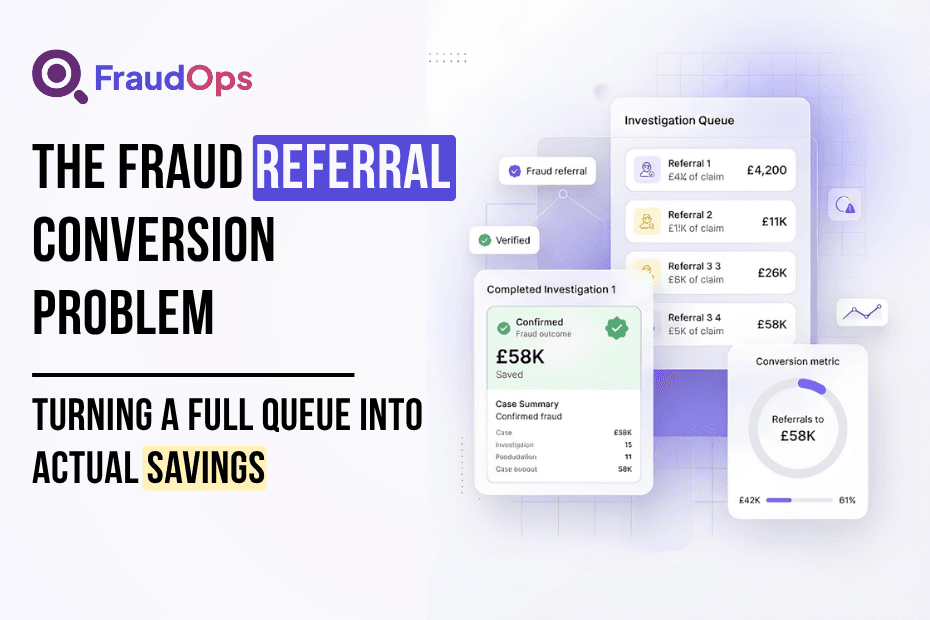
Fraud referral conversion is the share of detected referrals a team works through to a confirmed outcome and a captured saving. Detection fills the queue; conversion decides what the business actually keeps. Most counter-fraud savings leak not at detection but in the gap between a referral landing and the case being worked.
That gap is the least-measured part of most fraud operations. Insurers can tell you how many alerts their detection layer produced last quarter. Far fewer can tell you what proportion of those referrals were worked to a decision, how many settled by default because nobody got to them in time, or how much identified fraud was actually recovered rather than simply flagged. The referral queue looks like a measure of activity. It is really a measure of unconverted savings sitting in a list.
The Referral Queue Is A Funnel, And Every Stage Leaks Value
A fraud referral is not a saving. It is the start of a process that has to run to completion before any money is kept in the business. A referral has to be triaged, assigned, investigated, decided, and then have its outcome and indemnity figure captured. Drop the ball at any stage and the referral produces nothing, however strong the original signal was.
UK insurers detected £1.16 billion of fraudulent general insurance claims in 2024, across more than 98,400 cases — a 12% rise in case volume on the year before (ABI, November 2025). Motor alone accounted for 51,700 detected scams worth £576 million. Every one of those cases had to be worked by a person before it counted as a saving rather than a suspicion.
Think of the queue as a funnel. Referrals enter at the top; confirmed, captured savings come out of the bottom. The width of the funnel at each stage — how many referrals survive triage, get assigned, get worked before the clock runs out — is the fraud referral conversion rate. It is the single number that decides how much of a full detection pipeline turns into money, and it is the number almost nobody puts on a board pack.
Where Fraud Referral Conversion Breaks Down Between Referral And Outcome
Conversion breaks at four points, and none of them is a detection failure.
The first is triage. When every referral arrives in the same undifferentiated queue, the highest-value and time-critical cases are not reliably worked first. A £200,000 organised-ring case and a low-value opportunistic exaggeration wait in the same line. The team is busy, but not necessarily busy on the cases where the saving is largest.
The second is capacity. A referral that is not picked up before a claim’s settlement deadline converts to nothing, because the claim pays out while it is still sitting in the queue. This is the most expensive leak of all: the case was correctly identified, and the money left anyway.
The third is evidence friction. Investigators lose hours moving between LexisNexis, Experian, DVLA, Companies House, the IFB and IFR feeds and the internal claims system, re-keying the same details into each. Time spent chasing information is time not spent closing cases, and it caps how many referrals a fixed team can convert in a week.
The fourth is capture. When outcomes and indemnity savings are reconstructed at month-end from spreadsheets and memory rather than recorded against the case as it closes, savings are understated, attribution is weak, and the conversion rate itself becomes impossible to see. What cannot be measured cannot be defended in a budget conversation.
Why More Referrals Can Mean Less Saved
The intuitive assumption is that a better detection layer produces more savings. Beyond a point, the opposite is true. Detection has scaled fast — 83% of fraud leaders report rising opportunistic claims fraud and 52% flag organised fraud as a growing concern (LexisNexis Insurance Fraud Research Report 2025/26) — while investigation headcount has stayed broadly flat. More referrals arrive; the same team works them.
When inflow rises faster than a fixed team can convert, the fraud referral conversion rate falls even as raw savings hold steady, and the backlog grows. Each additional referral past the team’s capacity ceiling converts at close to zero, because it joins a queue that is already longer than the working week allows. Buying another scoring engine at that point adds referrals to a queue that is already too long. It raises the top of the funnel without widening anything below it.
This is why alert volume is a misleading headline. A fraud operation can post record detection numbers while its conversion rate — and its actual savings per referral — is falling. The counter-fraud metrics that belong on a board pack measure outcomes and conversion, not the loudness of the detection layer. (Cifas recorded more than 16,000 insurance cases on the National Fraud Database in 2025, up 26% on the year — more signal, again, for the same teams to convert (Cifas Fraudscape 2026).)
Slow Conversion Is Now A Fair-Treatment Problem, Not Just An Operational One
There is a second cost to weak conversion, and it lands on the honest claimant. A genuine claim held in a long investigation because the queue was backed up is a customer-experience failure before it is anything else. The FCA’s July 2025 review of home and travel claims handling found firms leaning too heavily on process-based management information and lacking direct evidence of what customers actually experienced (FCA).
Conversion speed is where that pressure bites. A fraud function that converts referrals quickly and consistently resolves genuine claims faster too, because cases do not sit in an undifferentiated backlog waiting for someone to reach them. Slow conversion holds up the fraudulent and the legitimate alike. Fixing the funnel is not only a savings argument; it is part of a defensible answer to how customers are treated at the claims stage.
How To Lift Fraud Referral Conversion Without Adding Headcount
Conversion is a capacity problem before it is a skill problem. The investigators are capable; the process around them leaks their time. So the lever is not more people — it is removing the friction that caps how many referrals each person can work to an outcome.
That is the job an investigations workbench does downstream of detection. FraudOps takes the referral pipeline the detection systems produce and works it on a single surface: intake into a managed, prioritised queue, evidence and intelligence in one place instead of across seven tabs, decision and outcome captured against the case as it closes. Its matching engine runs across parties, past cases, connected data and the intelligence database to surface linked claims and organised activity so the highest-value cases are worked first. Three AI agents — the Case Handler Agent, the Intel Agent and the Investigation Assistant Agent — take on the routine chasing, while every decision stays human-in-the-loop with a full audit trail. AI does the lookups; the investigator makes the call.
The effect shows up directly in the funnel. Running it this way has delivered a 95% decrease in outstanding referrals and 25 to 30% faster investigation completion year on year — across more than 50,000 settled investigations and £150 million-plus of suspected claims managed, now live with a Tier 1 UK insurer and a UK third-party administrator. A 95% cut in the backlog is what a wider funnel looks like in practice: not more referrals in, but far more of the referrals you already have converted to an outcome. For a four-person TPA team, the process efficiency alone was worth £26,128 a year before any fraud-outcome savings were counted.
Conclusion
Detection decides how many referrals you have; fraud referral conversion decides how much you keep. The savings leak is downstream of the alert — in the triage that never prioritised, the case that settled before anyone reached it, and the outcome that was never captured. The next gain in counter-fraud savings for most UK insurers is not another scoring engine feeding an already-full queue. It is a wider funnel: converting the referrals you already have, faster and more consistently, into outcomes the board can see.
Frequently Asked Questions
1. What Is Fraud Referral Conversion?
Fraud referral conversion is the proportion of detected fraud referrals that a team works through to a confirmed outcome with the saving captured. It is the funnel from referral to result: how many suspicious claims flagged by detection actually become recovered or declined savings, rather than sitting unworked in a queue.
2. Why Do Counter-Fraud Savings Leak After Detection?
Because a referral only becomes a saving once it is triaged, assigned, investigated, decided and captured. Savings leak when high-value cases are not prioritised, when referrals settle before the team reaches them, when investigators lose time chasing data across multiple systems, and when outcomes are reconstructed at month-end rather than recorded as cases close.
3. Does Buying More Fraud Detection Increase Savings?
Not once investigation capacity is the bottleneck. When referrals arrive faster than a fixed team can work them, extra detection adds to a queue that is already too long and converts at close to zero. Beyond that point, the gain comes from lifting conversion — working existing referrals to an outcome — not from generating more alerts.
4. How Can A Fraud Team Improve Conversion Without Hiring More Investigators?
By removing the friction that caps each investigator’s throughput: routing referrals into a single prioritised queue, bringing evidence and intelligence onto one surface instead of many portals, using AI to automate routine lookups under human review, and capturing outcomes against the case automatically. That widens the funnel with the team already in place.
5. What Tools Help Improve Fraud Referral Conversion?
An investigations workbench that sits downstream of detection is the direct lever. FraudOps routes referrals into a single prioritised queue, brings evidence and intelligence onto one surface, and uses AI agents to automate the routine chasing under human review — lifting how many referrals a team converts to an outcome without adding headcount. It is live with a Tier 1 UK insurer and a UK TPA, where it has cut outstanding referrals by 95%.