
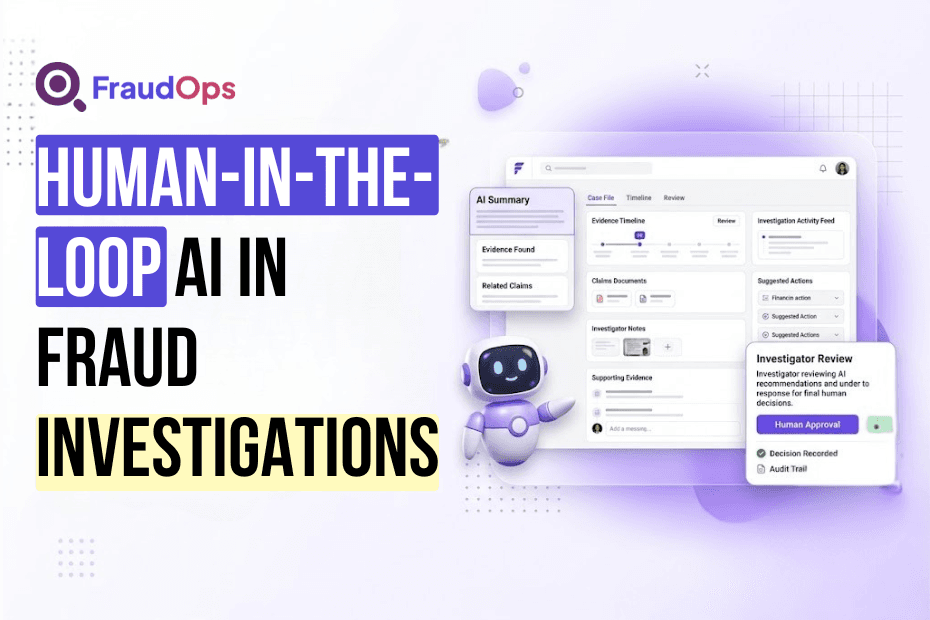
Human-in-the-loop AI in fraud investigation means the AI handles retrieval, drafting and pattern-matching, while a named investigator reviews the output and makes every material decision. Regulators and investigators want the same thing from it: a clear record of what the AI did, who checked it, and why the decision stands.
That sounds like a compliance line. It is really an operational one. The teams getting AI to work in fraud investigation are not the ones who handed the most decisions to a model. They are the ones who worked out, early, which parts of the job a machine should touch and which parts a person must own.
Why Investigators And Regulators End Up Asking The Same Question
Start in the investigator’s chair, not the rulebook. A referral lands. An AI agent has already read the claim file, pulled the parties, run the standard database checks and drafted a summary. The investigator now has to decide: repudiate, pay, investigate further, or close. If that decision is later challenged — by a complaint, by the Financial Ombudsman, by an internal reviewer — the investigator is the one who has to defend it.
What they need before they’ll trust the AI is simple. Show me what you did. Show me the evidence you used. Let me change it. That is not caution for its own sake; it is the instinct of someone who knows their name is on the outcome.
The regulator arrives at the identical requirement from the other direction. Handing a decision to an algorithm does not hand over the responsibility for it. Someone is still accountable, and they have to be able to explain what happened. So the investigator who wants to see the AI’s working and the regulator who wants a defensible record are asking for the same thing. Human-in-the-loop is where those two demands meet.
The pressure behind the question is real. UK insurers identified £1.16 billion of fraudulent general insurance claims in 2024, across more than 98,400 detected cases — a 12% rise in volume on the year (ABI). The mix keeps shifting, too: Cifas recorded a 26% rise in identity fraud filings in the insurance sector in 2025, to more than 16,000 cases (Cifas Fraudscape 2026). More cases, more automation to work them, and more scrutiny of how each decision was reached.
What Human-In-The-Loop Actually Means, Past The Slogan
“Human-in-the-loop” gets used as a reassurance and left undefined. In a fraud investigation it has to mean something specific, or it means nothing.
It means the AI accelerates the investigator and never stands in for them. The Case Handler Agent reads unstructured documents and extracts the parties and facts. The Intel Agent runs searches across connected data sources. The Investigation Assistant Agent speeds up the routine steps. None of them decides whether a claim is fraudulent. They assemble; the investigator determines.
It also means every one of those AI actions is visible, reversible, and recorded against a named person. Not “the system flagged this claim” but “the Intel Agent surfaced these three matches, the investigator reviewed them on this date, and made this decision for these reasons.” The difference between those two sentences is the difference between a decision you can defend and one you can only assert.
This is where a lot of AI-in-fraud talk falls down. The tools that survive contact with a real SIU are the ones that reduce the assembly and retrieval work eating an investigator’s day, freeing experienced people for the judgement that decides whether a referral converts into a saving. That is what AI actually does well in fraud investigation, and it is a narrower claim than most vendors make.
Full Autonomy Is Rare — The Real Risk Is The Undocumented Shortcut
The market has already, quietly, settled this. In the most recent Bank of England and FCA survey of AI in UK financial services, 75% of firms reported using AI, but only 2% of use cases were fully autonomous — the rest kept a human in the decision (Bank of England / FCA, 2024). Full automation of consequential decisions is not what firms are actually doing, whatever the headlines suggest.
So the risk is not that fraud teams will hand investigations to autonomous machines. It is subtler. It is the informal shortcut: an investigator who leans on an AI summary without recording that they checked it, a prioritisation the model made that nobody wrote down, a decision where the human was technically in the loop but left no trace of having been there. The loop existed. The evidence of it did not.
That gap only shows up when a case is challenged, and by then it is too late to reconstruct. The fix is to capture the human’s involvement as the work happens, not to remember it afterwards.
The Regulator's Position: Accountability Doesn't Move To The Model
The UK regulator’s approach here is light-touch by design, and worth understanding on its own terms rather than as a box-ticking exercise. The FCA has said it does not plan to introduce AI-specific rules, relying instead on existing frameworks — the Consumer Duty and the Senior Managers and Certification Regime — which already place accountability for outcomes with named senior individuals (FCA).
Read that as an operator and it is clarifying, not constraining. There is no separate AI rulebook coming to hide behind. The question a reviewer will ask about an AI-assisted decision is the same question they ask about any decision: who was responsible, and can they show it was reached fairly and on evidence. The regulator models the posture itself. In its own use of AI, the FCA notes that its people “remain integral, using their expertise for judgement, while AI focuses on pulling out facts and analysing unstructured text.” That is human-in-the-loop, described by the body that would judge you on it.
What This Looks Like In The Investigator's Workbench
The reason human-in-the-loop erodes in practice is rarely bad intent. It is that capturing every AI-assisted step by hand, across spreadsheets and inboxes, is more work than the day allows. So it is where good fraud case management and investigation software earns its place — by making the record a by-product of the work rather than a separate task.
In FraudOps, the three agents accelerate the investigator while every action they take is logged, timestamped and attributed, and every AI-assisted step carries the human sign-off behind it. Decisions, the evidence chain, the searches run — all captured as they happen, under defined retention and access rules. That is what turns a sound investigation into a defensible one, and it is the same discipline behind building a fraud investigation audit trail that holds up. It is also why FraudOps’s 50,000+ settled investigations sit on a record that can be reconstructed long after each case closed.
None of this slows the good investigator down. Teams working this way complete investigations 25–30% faster year on year, because the AI removes the retrieval grind, not the judgement. The judgement — and the accountability for it — stays exactly where the investigator and the regulator both want it: with a person. That principle sits at the core of how FraudOps approaches investigation case management.
Conclusion
Human-in-the-loop AI is not a hedge against the technology; it is the condition that makes the technology usable in a function where every decision may be examined. Let AI do the assembly and keep the determination with a named person, then record both, and the investigator gets their time back while the regulator gets a defensible file. The teams that treat that record as a by-product of the work, not an afterthought, are the ones who will keep the benefit of AI without inheriting its liability. With the government committing over £250 million to its Fraud Strategy 2026–2029 (GOV.UK), the scrutiny on how fraud decisions are made is only going to sharpen.
Frequently Asked Questions
1. What does human-in-the-loop AI mean in fraud investigation?
It means AI performs the retrieval, extraction and drafting work — reading documents, running searches, summarising cases — while a named investigator reviews the output and makes every material decision. The human is never removed from a consequential call, and each AI-assisted step is recorded with the person who reviewed and approved it.
2. Do UK regulators require a human in the loop for AI fraud decisions?
The FCA has not issued AI-specific rules, relying instead on existing frameworks like the Consumer Duty and the Senior Managers and Certification Regime. Those place accountability for outcomes with named individuals, so a decision cannot be attributed to a model alone — a person must be able to explain and stand behind it.
3. How does human-in-the-loop AI affect the audit trail?
It raises the bar. Every AI-assisted action must be visible and reversible, with a named human signing it off. A reviewer is entitled to ask why a case was summarised, prioritised or actioned in a particular way, so the record has to show that AI accelerated the investigator rather than replaced them, capturing each step as it happened.
4. Is fully autonomous AI used to decide insurance fraud cases?
Rarely. In the most recent Bank of England and FCA survey, only 2% of AI use cases in UK financial services were fully autonomous. Consequential decisions almost always keep a human in the loop, both because firms remain accountable for the outcome and because a defensible decision needs a person behind it.
5. How can a fraud team keep AI human-in-the-loop without adding admin?
Use a workbench that captures the record automatically. In FraudOps, the Case Handler, Intel and Investigation Assistant agents do the retrieval and drafting, while every action is logged, timestamped and attributed with the investigator’s sign-off — so the human-in-the-loop trail is a by-product of the work, not a separate task.