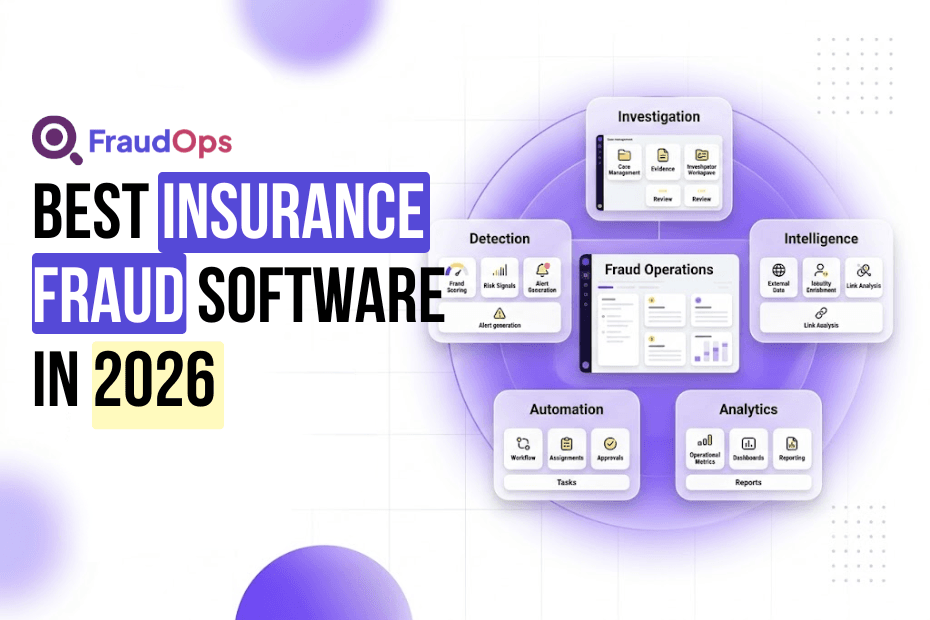
The best insurance fraud software depends on the job you need done. Detection platforms such as Quantexa, Shift Technology and FRISS find suspicious claims; fraud case management and investigation software such as FraudOps turns those alerts into worked cases, savings and defensible outcomes. Mature counter-fraud operations run both layers together.
Two different jobs, one fraud stack
Best insurance fraud software” is really two questions. The first is how you find suspicious claims — detection. The second is what happens next: who investigates, how evidence is gathered, whether outcomes hold up to scrutiny, and what the operation saves — investigation management. UK insurers have spent a decade investing well in the first job. The second is where most of the value now leaks: referrals tracked in spreadsheets, investigators juggling seven portals, and savings figures assembled by hand at month end.
This guide covers the leading tools in each layer and — more usefully — how they fit together. FraudOps sits in the investigation layer and integrates with the detection tools below, so consider the framing here: these are complementary layers, not rivals.
The detection layer: finding suspicious claims
Quantexa
Quantexa is the reference point for contextual decision intelligence at enterprise scale — entity resolution and network analytics that connect people, businesses and claims across huge datasets. Tier 1 insurers use it to surface organised fraud that rule-based screening misses.
Symphony AI (NetReveal)
Symphony AI‘s NetReveal heritage makes it one of the most established fraud and financial-crime analytics suites in insurance, with deep detection and scoring capability across claims and application fraud.
Shift Technology
Shift Technology brought AI-native claims fraud detection to the mainstream — strong document analysis and triage decisions delivered into the claims workflow.
FRISS
FRISS provides real-time fraud and risk scoring across underwriting and claims, popular with insurers wanting fast time-to-value on detection, and offers investigation tooling in its wider suite.
Specialists: Clearspeed and Carpe Data
Clearspeed adds voice-based risk assessment at claim intake; Carpe Data brings online and social data to claims screening and SIU work. Both slot into either layer of the stack.
The investigation layer: turning alerts into outcomes
Detection output is a starting pistol, not a result. The investigation layer is where referrals are triaged, cases worked, intelligence connected, and savings evidenced.
FraudOps
FraudOps is fraud case management and investigation software built specifically for insurance — an AI-powered investigations workbench covering referral management, case lifecycle, intelligence and watchlists, operations for organised fraud, and board-ready MI. It connects to the detection platforms above, pulling scores and alerts into cases and pushing enriched outcomes back, and its Rapid Screen module adds a lightweight automated screen at the top of the funnel for teams without an enterprise detection tool. Clients include Zurich Insurance; results include a 95% reduction in outstanding referrals and 25–30% faster investigation completion year on year, with £150m+ of suspected claims managed through the platform. Every AI action is human-supervised with a full audit trail — relevant under FCA Consumer Duty.
Case IQ
Case IQ is a strong configurable investigation platform used across HR, compliance and fraud. For teams whose remit spans well beyond insurance claims — internal fraud, whistleblowing, broker conduct — its breadth is attractive; insurance-specific workflow comes through configuration.
DTx
DTx offers UK-hosted investigations case management with strong security certifications, used by public-sector and counter-fraud teams; insurers valuing UK hosting and court-bundle preparation shortlist it alongside insurance-specific options.
How to choose: match the software to the gap
If suspicious claims are getting through unflagged, your gap is detection — look at Quantexa, Symphony AI, Shift or FRISS. If your detection pipeline is full but referrals queue in spreadsheets, cycle times stretch and savings are hard to evidence, your gap is investigation management — that is the job FraudOps was built for. If you have neither, start with the investigation layer plus lightweight screening (Rapid Screen), and add enterprise detection as volumes justify it. The layers reinforce each other: better investigation outcomes feed back to sharpen detection models, and better detection focuses investigator effort.
Frequently asked questions
Do I need both detection and investigation software?
Mid-size and large insurers generally end up with both: detection to find suspicious claims at volume, and investigation software to work them consistently and evidence outcomes. Smaller teams and TPAs often start with investigation software plus lightweight screening.
Can FraudOps replace my detection platform?
No — and it is not designed to. FraudOps integrates with detection platforms rather than replacing them, converting their alerts into worked cases. Its Rapid Screen module provides lightweight fraud flag scoring for teams without enterprise detection, but it runs no proprietary predictive models.
What does insurance fraud investigation software cost?
Investigation platforms are typically priced per user. FraudOps publishes indicative bands from around £1,000–£1,500 per month for small investigation firms and TPAs, scaling with team size for larger insurers. Enterprise detection platforms are usually custom-priced.
Conclusion
There is no single “best” insurance fraud software — there is a best-fit stack. Detection finds the claims worth looking at; fraud case management and investigation software makes the looking pay. If your investigation function still runs on spreadsheets, that layer is where the quickest, most measurable gains sit. Book a demo to see the investigation layer working with your existing detection stack.