
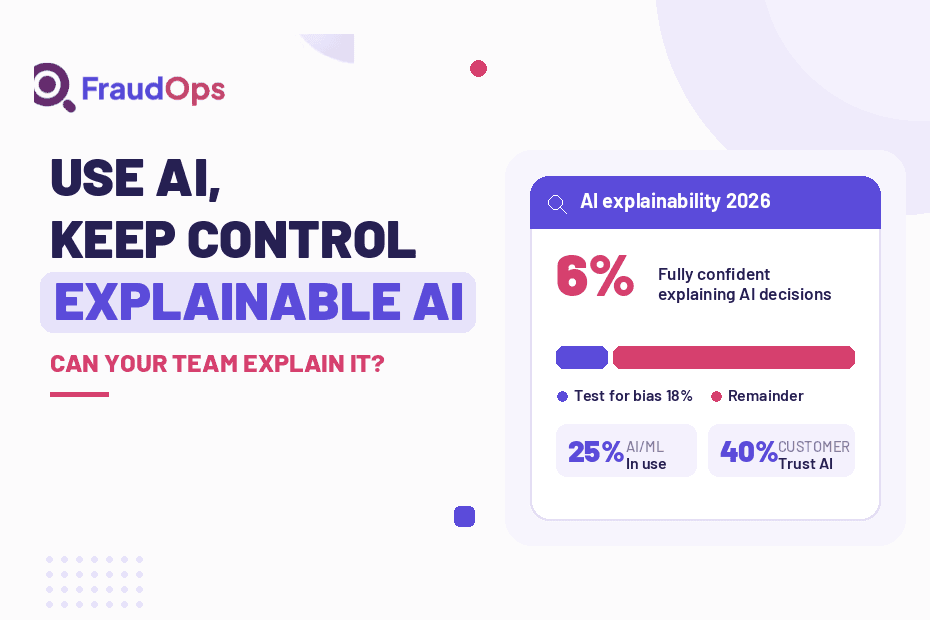
Insurers are bringing AI into counter fraud work quickly, yet very few teams can explain what their models are doing. The 2026 technology benchmarking report from SAS found that only 6% of fraud professionals feel completely confident explaining how AI models make counter fraud decisions. That gap matters, because every fraud decision affects a real customer and may later be challenged. In this article, we look at why explainable AI fraud investigation matters, where explainability tends to break down, and the practical steps SIU teams can take to keep experienced investigators firmly in control of each decision.
Key Takeaways
A handful of 2026 studies show how quickly AI in fraud investigations is spreading and how far explainable AI fraud investigation has fallen behind.
- Explanation Gap: Only 6% of 713 fraud professionals feel completely confident explaining how AI models make counter fraud decisions (SAS).
- Bias Rarely Tested: Only 18% of their organisations test AI models for bias or fairness.
- Adoption Widespread: EIOPA found that nearly two thirds of 347 insurers across 25 countries already actively use generative AI (EIOPA).
- Customer Trust Falling: Confidence in insurers’ use of AI fell to 40% in 2026, down on 46% in 2025 (Digital Insurance).
AI Is Arriving Faster Than the Explanations
AI in fraud investigations is no longer experimental. The ACFE and SAS report found that 25% of organisations now use AI or machine learning in their counter fraud programmes, up on 18% in 2024, with a further 28% expecting to adopt it by 2028. Across European insurance, EIOPA’s Generative AI Market Survey found that nearly two thirds of insurers are already using the technology, although most remain at the proof of concept stage.
AI governance has not kept up with that adoption. The EY and Institute of International Finance survey of insurance chief risk officers found that 62% of firms have enterprise AI governance structures and 55% have formal AI policies (EY). KPMG found that only 15% of insurers have AI governance fully integrated into strategic planning (Insurance Edge). For counter fraud teams, that leaves explainable AI fraud investigation resting on individual habits rather than agreed standards.
Why Explainable AI Fraud Investigation Matters
Fraud decisions carry consequences that most other AI uses do not. A declined claim, a referral to the police or a cancelled policy all affect a customer directly, which is why the reasoning behind each decision needs to be clear and recorded.
Decisions Affect Real Customers
Customers are already wary of AI making decisions about them. Insurity’s 2026 AI in Insurance Report, based on a survey of over 1,000 consumers, found that nearly half distrust AI making decisions such as claims approvals, fraud detection and policy adjustments, and only a third trust AI driven insurance decisions overall (Business Wire). Smart Communications‘ research also found that 85% of customers say it is very important that insurers disclose when AI is used in communications.
Under the FCA’s Consumer Duty, insurers are expected to deliver good outcomes for customers. When a decision rests partly on an AI output, the insurer needs to be able to show how that output was used and why the final decision was fair, which is the core purpose of explainable AI fraud investigation.
Regulators Expect Clear Reasons
The ICO and The Alan Turing Institute have published joint guidance, Explaining Decisions Made With AI, which gives organisations practical advice on explaining AI assisted decisions to the people they affect (ICO). The ICO notes that the guidance is under review following the Data (Use and Access) Act, so counter fraud and compliance teams should check the latest version before relying on it. Its direction is clear, though: organisations need to explain AI assisted decisions to the people they affect, and assign clear roles, policies and documentation to support that.
Where AI Explainability Breaks Down
When teams use AI in fraud investigations, AI explainability tends to fail in a few predictable places. The most common is when a risk score is treated as a finding, so that a claim is handled differently because a model flagged it, without anyone recording what evidence the investigator then gathered or how they reached their conclusion.
A second weak point is the record itself. If an AI tool summarises documents, gathers intelligence or drafts case notes, but the case file does not show what the tool produced and what the investigator checked, the reasoning becomes impossible to reconstruct later. A third is testing, since the ACFE and SAS finding that only 18% of organisations test AI models for bias or fairness suggests that many teams have little evidence that their models treat customers consistently, which weakens any attempt at explainable AI fraud investigation.
Practical Steps for Explainable AI Fraud Investigation
None of this means insurers should avoid AI. It means building the investigation process so that every AI contribution is visible, human oversight is constant, and every decision belongs to a person.
The following steps give SIU teams a practical starting point.
- Investigators Decide: Use AI to gather intelligence, summarise evidence, and draft routine updates, while the investigator directs the case and makes each decision, so human oversight is built into the workflow.
- Record AI Contributions: Log what each AI tool produced and what the investigator reviewed, changed or rejected, so the case file shows how the conclusion was reached.
- Keep an Audit Trail: Capture every action, source and decision in one case record, so the insurer can answer a complaint, an Ombudsman referral or a regulator’s question with evidence rather than memory.
- Test for Bias: Ask detection and scoring providers how their models are tested for bias and fairness, and review outcomes across customer groups regularly.
- Explain in Plain Language: Make sure investigators can describe in ordinary words why a case was flagged and what evidence supported the outcome.
Taken together, these steps turn explainable AI fraud investigation into a working habit, so explainability is built into each case rather than added after a complaint arrives.
Frequently Asked Questions
It means being able to show clearly how an AI tool contributed to a fraud decision, including what it produced, what the investigator checked and why the final outcome was reached. The aim of explainable AI fraud investigation is a decision that can be explained to the customer, the Ombudsman or a regulator.
According to the 2026 ACFE and SAS benchmarking report, only 6% of 713 respondents feel completely confident explaining how AI models make counter fraud decisions.
Fraud decisions directly affect customers, and insurers must be able to show those decisions were fair under the FCA’s Consumer Duty. Clear explanations also help defend decisions if they are challenged through a complaint or the Financial Ombudsman Service.
AI is most useful for gathering intelligence, summarising documents and handling routine admin, while an experienced investigator weighs the evidence and makes the call. Keeping human oversight in place makes decisions easier to explain and defend.
FraudOps is an AI powered investigations workbench for insurance fraud teams. AI and automation handle the brunt work, while the investigator directs the case and makes every call, and every action is captured in a full audit trail. FraudOps connects to existing detection and scoring tools rather than building its own predictive models.
Bottom Line
AI can make fraud investigations quicker and more thorough, but only if every decision remains explainable. With just 6% of fraud professionals fully confident explaining their AI decisions, the practical priority for SIU teams building explainable AI fraud investigation is to keep investigators in charge of each outcome, record exactly what AI contributed, and maintain an audit trail that lets any decision be explained clearly to the customer it affects.