
A stale fraud investigation case has gone quiet: no new evidence, task or decision logged for weeks, while still sitting inside its SLA. Most SIU teams measure time to a deadline, not time since the last action, so these cases stall unnoticed until the evidence cools and the claim resolves badly.
Key Takeaways
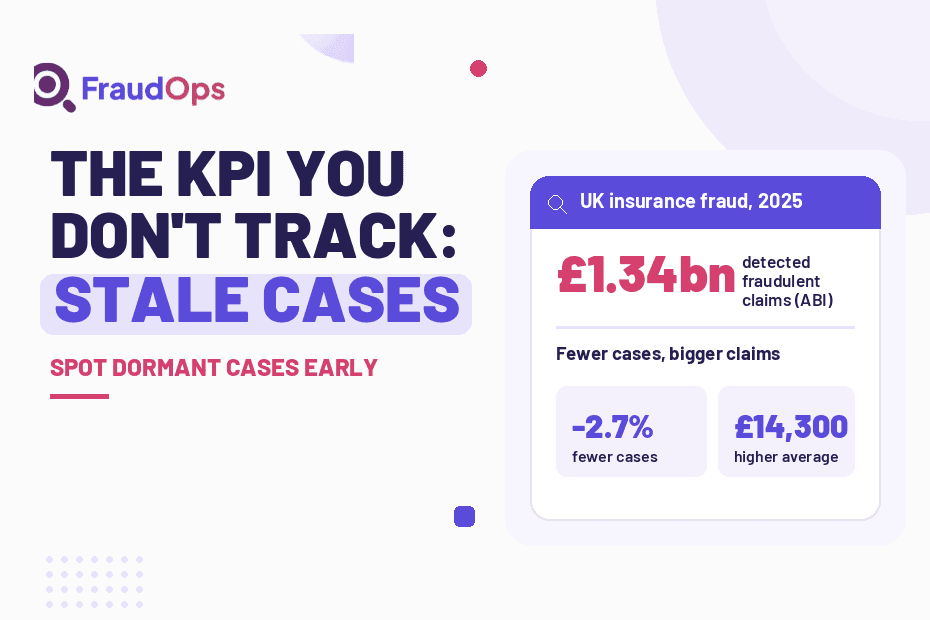
- UK insurers detected £1.34 billion of fraudulent general insurance claims in 2025, up 14% on 2024, even as the number of detected cases fell 2.7% to 93,900 (ABI). Fewer but larger claims mean longer, more complex investigations.
- The average detected fraudulent claim reached £14,300 in 2025, the highest since 2022, as fraudsters target bigger payouts (ABI).
- An SLA measures time left until a deadline. Case staleness measures time since the last meaningful action, so a case can be stale for weeks while still, on paper, “in time”.
- The Financial Ombudsman Service received 45,606 insurance complaints in 2024/25 and upheld 38% of them, part of its highest total complaint volume in six years (FOS).
- In its 2025 review of home and travel claims handling, the FCA found “unnecessarily long claims handling times”, with one firm’s service levels “consistently outside of tolerance throughout 2024” (FCA).
What Makes a Fraud Investigation Case Stale, and Why an SLA Misses It
A fraud investigation case is stale when nothing has moved on it for a defined period, regardless of how far it still is from its deadline. An SLA counts down to a date; staleness counts up from the last real action, which is a different thing entirely. UK insurers detected 93,900 fraudulent general insurance claims in 2025, worth £1.34 billion (ABI), and each one entered an investigation queue. In a busy SIU, the cases that get worked are the ones with a looming SLA or a shouting stakeholder. The quiet ones, waiting on a vendor response or a colleague’s input, simply wait. No alarm sounds, because no rule has been broken yet.
That is the blind spot. A case can sit for three weeks with no activity and still be comfortably inside a 60-day SLA, so it never surfaces on a breach report. By the time the deadline does approach, the investigator is working cold: the claimant has moved on, the data vendor result has expired, and the thread of the case has to be picked up from scratch.
Staleness and SLA Breach Measure Two Different Things
An SLA breach tells you a case ran out of time; staleness tells you a case is losing momentum before it runs out of time. The distinction matters because the first is a lagging indicator and the second is a leading one. A Head of Fraud who only watches SLA breaches is reading yesterday’s weather. The FCA, reviewing home and travel claims handling, found firms with “unnecessarily long claims handling times” and one firm whose service levels were “consistently outside of tolerance throughout 2024”, noting that firms “were often too slow to address the root cause” (FCA). Cases do not fail suddenly. They drift, and the drift is visible weeks before the breach if anyone is measuring it.
| SLA / deadline metric | Case staleness metric | |
|---|---|---|
| What it counts | Time left until the due date | Days since the last meaningful action |
| When it flags | At or near breach | While the case is still “in time” |
| Indicator type | Lagging | Leading |
| What it catches | Cases that already failed | Cases drifting toward failure |
| Typical response | Firefight the overdue case | Nudge the quiet case back into motion |
Why Stale Fraud Investigation Cases Are the Expensive Ones
The cases that go quiet tend to be the complicated, higher-value ones, which is exactly why staleness costs more than it looks. The average detected fraudulent claim reached £14,300 in 2025, the highest since 2022, with exaggerated loss the most common fraud type at 26,900 cases (ABI). A larger, exaggerated claim is rarely cleared in a single search; it needs medical evidence, prior-claims checks, sometimes surveillance, each with its own wait. Every wait is a chance for the case to stall, and a stalled fraud case is one a fraudster can run down the clock on. As Mark Allen, Head of Fraud and Financial Crime at the ABI, put it, “fraudsters are targeting much bigger payouts.”
A fraudulent claim that times out settles. A genuine claim that stalls becomes a complaint. Staleness is the mechanism behind both outcomes, and neither shows up on a savings report until the money has already left. It is the same blind spot behind another metric SIU teams rarely watch, the decline overturn rate.
The Consumer Duty Cost of a Case That Goes Quiet
A genuine claimant sitting inside a dormant investigation is a Consumer Duty problem, not just an operational one. The Financial Ombudsman Service handled 45,606 insurance complaints in 2024/25 and upheld 38% of them, with car and motorcycle insurance the single most-complained-about insurance product at 14,082 cases (FOS). The FCA is explicit that under the Consumer Duty “firms must act to deliver good outcomes for all retail customers” (FCA). A fraud investigation that stops moving quietly fails that test twice over: the honest customer waits without explanation, and the firm cannot evidence that it was progressing the case at all. Tracking staleness is, in part, how a fraud team shows it did not leave a legitimate claimant stranded while a flag was checked.
What Actually Drives Cases Into Dormancy
Cases rarely go stale through neglect; they go stale through friction, as work hands off between people, systems and vendors with no single view of where it stopped. An investigator waits on a LexisNexis or Companies House result, a case moves from claims to the SIU and back, an intel request sits in someone’s inbox. Each handoff is a seam where a case can quietly stop. Pressure on capacity makes it worse: half of UK adults (50%) now believe first-party fraud is “reasonable”, up from 48% a year earlier (Cifas), which means more opportunistic claims entering the funnel and more work competing for the same investigator hours. When capacity is the binding constraint, the cases without a deadline shouting at someone are always the ones that slip.
How to Track Case Staleness Without Adding Admin
The practical fix is to measure one number per case, days since the last logged action, and surface the cases where that number is climbing. Set the threshold well inside your SLA: if the deadline is 60 days, a fortnight of silence is already worth a look. Three habits make it work:
- Record activity consistently, so “last action” means something. A case with no logged events is indistinguishable from a case nobody has touched.
- Review a dormancy list, not just a breach list. The breach list is who already failed; the dormancy list is who is about to.
- Give the drift an owner. A quiet case needs a nudge, a reassignment or a decision to close, not another month of silence.
This is where a single investigations workbench earns its place over spreadsheets and a shared inbox. When case activity, tasks, intel searches and status sit in one surface with a full audit trail of every action, the last-activity date is captured automatically rather than reconstructed from memory. Dedicated SIU case management software like FraudOps gives fraud teams around a 30% time saving on intel gathering and case admin, measured against manual searches and case handling, which is time that would otherwise go into chasing where a case got stuck. The investigator still directs the case and makes every call; the workbench just stops cases from disappearing between the cracks.
Conclusion
Case staleness is the leading indicator that SLA breaches and board-level savings reports both miss. A case that has gone quiet is cheap to fix and expensive to ignore, because the cost of a stalled investigation, whether a settled fraud or an upheld complaint, only appears once it is too late to prevent. Measure days since the last action, review the drift before the deadline, and the backlog stops hiding its most expensive cases.
Frequently Asked Questions
A stale fraud investigation case is one that has had no new activity, evidence, task or decision for a set period, while still being within its SLA. It is defined by inactivity rather than by a missed deadline, which is why a case can be stale and on time at once.
An SLA breach is a lagging measure: it confirms a case has already run out of time. Case staleness is a leading measure: it counts the days since the last meaningful action, flagging cases that are drifting toward a breach while there is still time to intervene.
There is no single industry standard; the sensible approach is to set the threshold well inside your SLA. If your investigation SLA is 60 days, a case with no activity for around two weeks is already worth a review, because the earlier the drift is caught, the cheaper it is to correct.
Cases usually stall at the seams, waiting on a data-vendor result, an intel request or a handoff between claims and the SIU, rather than through neglect. With more opportunistic claims entering the funnel, the cases without a looming deadline are the ones that quietly lose momentum when investigator capacity is stretched.
FraudOps is an AI-powered investigations workbench that brings case activity, tasks, intelligence and status into one surface with a full audit trail, so the last-action date on every case is captured automatically. That makes dormant cases visible to a Head of Fraud Operations before they breach, while the investigator keeps control of every decision.