
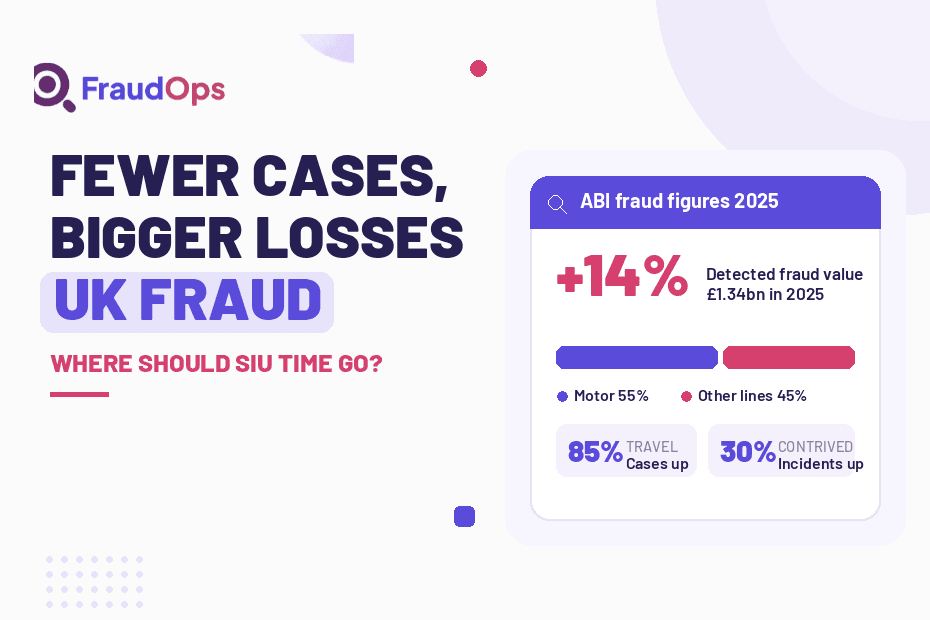
UK insurers detected £1.34bn of fraudulent general insurance claims in 2025, according to the Association of British Insurers, yet the number of detected cases fell by 2.7% to 93,900. Fewer cases carrying bigger losses is now the defining pattern in UK insurance fraud, and it changes where investigator time delivers the strongest return. In this article, we look at what the latest ABI fraud figures actually show, which types of claim are pushing the value up, and how busy SIU teams can rethink referral triage so that their most experienced investigators spend their time on the cases that matter most.
Key Takeaways
The ABI’s 2025 data, published in October 2026, contains a handful of figures that every counter fraud team should have to hand.
- Value Up Sharply: Detected insurance fraud reached £1.34bn in 2025, a rise of 14% on £1.18bn in 2024 (ABI).
- Cases Down Slightly: Detected cases fell by 2.7% to 93,900, so the growth in value came from bigger claims rather than a larger number of them.
- Average Claim Climbing: The average fraudulent claim reached £14,300, the second highest on record after £14,600 in 2022.
- Exaggeration Leads: Exaggerated loss was the most common fraud type, with 26,900 cases of claimants inflating a genuine loss.
What the ABI’s 2025 Fraud Figures Actually Show
The headline for UK insurance fraud in 2025 is simple: insurers found less fraud by count and considerably more by value. The ABI recorded £1.34bn of detected fraudulent claims across 93,900 cases, which puts the average fraudulent claim at £14,300. Mark Allen of the ABI summed it up by saying that “fraudsters are targeting much bigger payouts” (Insurance Business).
Underneath that headline, the picture varies a great deal by line of business, and those differences are where the practical lessons for SIU teams sit.
Motor Still Dominates the Caseload
Motor remains the largest single source of detected insurance fraud. According to the ABI, motor accounted for 51,900 detected cases in 2025, which is 55% of the total, with a combined value of £625m. Case numbers were almost flat on the previous year, rising by just 0.4%, yet the average motor fraud claim of around £12,000 was the second highest since 2015.
That pattern matches what individual insurers are reporting about UK insurance fraud in their own books. Aviva, which now includes Direct Line, said that motor made up over 70% of its detected fraud cases in 2025 and that the value of detected motor fraud rose by 39% (Aviva). Aviva also described a shift away from staged collisions towards exaggerated damage, repair, credit hire and injury claims, which helps explain why values are climbing while volumes hold steady.
Property and Travel Are Moving in Different Directions
Property fraud tells a similar story about value. Detected property cases fell by 6.2% to 17,700, while their value rose by 3.4% to £201m, taking the average property fraud claim to a record £11,400 (UKGI summary of the ABI release).
Travel is the exception within the 2025 UK insurance fraud data, because it grew in volume. Detected travel cases rose by 85% to 4,500, although the total value of £8.6m means the average travel fraud claim sits just under £2,000. For most SIU teams, travel is therefore a volume problem rather than a value problem, and that distinction matters when deciding how to allocate investigators.
Why the Shift Towards Bigger Claims Matters for UK Insurance Fraud Teams
A rising average claim value changes the economics of every investigation. When each confirmed fraud is worth more, the cost of missing one also goes up, and the gap between a well chosen case and a poorly chosen one widens. This is the central reason the latest UK insurance fraud numbers deserve attention from anyone who manages a counter fraud budget.
Exaggeration Inside Genuine Claims
The ABI found that exaggerated loss was the most common type of detected insurance fraud, with 26,900 cases in which claimants inflated a loss that had genuinely happened. That finding is consistent with wider industry research into UK insurance fraud. In a survey by Insurance Post and CRIF, 80% of respondents named exaggerated or inflated claims as their biggest fraud problem, ahead of opportunistic claims fraud at 44% and application fraud at 40% (Insurance Post).
Exaggerated claims are difficult to investigate because the underlying loss is real. The investigator has to establish which parts of the loss are genuine and which are inflated, and that work usually involves checking repair costs, contents values, injury details or loss of earnings in some depth. These cases also carry a higher risk of getting the outcome wrong for an honest customer, which we return to later in this article.
Contrived Incidents and Technology
Contrived incidents, where the crash, loss or event is staged from the outset, rose by around 30% to roughly 5,600 cases in the ABI’s 2025 data. Allianz UK reported an even sharper pattern in its own book, with staged accidents up 84% and contrived accidents up 61% in 2025 (Allianz UK).
Technology is also making false claims look more convincing. Damian Rourke of Clyde & Co commented that fraudsters are “increasingly focused on maximising payouts, often using technology to make claims appear more credible”, and Aviva reported a growing number of claims backed by AI generated images and manipulated documents, mainly in motor. In the Insurance Post and CRIF survey, 68% of respondents said fraud had become more technologically enabled over the previous three years.
The Problem With Treating Every Referral the Same
Many SIU teams still work their queue broadly in the order referrals arrive, or allocate cases evenly across investigators regardless of what each referral is likely to be worth. That approach made more sense when UK insurance fraud values were relatively consistent, but the 2025 figures show a widening spread between a lower value travel claim averaging under £2,000 and a property or motor claim averaging over £11,000.
When every referral receives the same treatment, three things tend to happen. Experienced investigators spend part of their week on cases that would be better suited to a lighter review. The more complex, higher value cases wait in the queue alongside everything else. And the team’s reported savings depend more on which cases happened to arrive than on any deliberate choice about where to focus.
There is also evidence that teams tackling UK insurance fraud are already stretched. The Insurance Post and CRIF survey found that 49% of insurers cite technology limitations and resource constraints as their main barriers to tackling fraud. On the claims side, Capgemini’s World Property and Casualty Insurance Report 2026 found that 64% of adjusters struggle to meet turnaround times because of their caseloads (Capgemini). When capacity is limited, the order in which work is done becomes a strategic decision rather than an administrative one.
How SIU Teams Can Rethink Referral Triage
The 2025 data points towards a more deliberate approach to referral triage, where the likely value and complexity of a case shape how it is handled from the moment it arrives. None of this requires new fraud theory; it is mostly about making the existing judgement of experienced investigators visible and consistent across the team.
The following practices give SIU managers a practical starting point for aligning investigator time with the shape of UK insurance fraud shown in the latest figures.
- Value Based Prioritisation: Use the claimed amount, the line of business and the type of indicator raised to estimate the potential value of each referral, so that high value fraud claims reach an experienced investigator early rather than waiting in a general queue.
- Tiered Case Routes: Create separate handling routes for lighter checks and full investigations, so that lower value referrals such as many travel claims can be resolved quickly without consuming senior investigator time.
- Exaggeration Specific Checks: Build standard steps for exaggerated claims, such as verifying repair estimates, contents values and loss of earnings, because these cases make up the largest single fraud type in the ABI data.
- Early Enabler Review: Look at the third parties attached to a claim, including repairers, credit hire firms and loss assessors, since Aviva has identified professional enablers inflating repair costs and scopes of work.
- Outcome Feedback Loops: Record the outcome and value of every closed case against the original referral, so that triage rules improve over time based on what actually turned out to be fraud.
Triage only works if the information behind it is reliable. That means the referral, the evidence gathered, the decisions made and the final outcome all need to sit in one place, rather than being spread across email, spreadsheets and separate systems. Without that record, it is very hard to see which kinds of referral are producing the biggest savings, and harder still to show the board why the team is prioritising some cases over others.
Protecting Fair Outcomes for Genuine Customers
A focus on high value fraud claims carries a responsibility that SIU teams should keep in view. Exaggerated claims involve real losses and real customers, and getting the decision wrong has consequences both for the policyholder and for the insurer.
The Financial Ombudsman Service received 13,420 car and motorcycle insurance complaints in 2025/26 and upheld 35% of them, with buildings insurance complaints upheld at 38% (Financial Ombudsman Service). Under the FCA’s Consumer Duty, insurers are expected to deliver good outcomes for customers, which includes handling claims fairly and promptly, including those flagged as possible UK insurance fraud.
For SIU teams, the practical implication is that every decision on a higher value case should be supported by a clear, documented trail of evidence and reasoning. A well recorded investigation protects the insurer if a decision is challenged, and it also helps genuine customers by reducing the chance that a legitimate claim is delayed or declined without good cause. Prioritising the right cases and documenting them properly are two sides of the same discipline.
What the Numbers Mean for SIU Capacity
The latest ABI fraud figures suggest that the value of detected UK insurance fraud is growing faster than the number of cases. Allianz UK reported savings of nearly £174m from over 34,200 cases, and Aviva detected £233m across over 18,400 suspect claims, with both insurers describing record years. The City of London Police’s Insurance Fraud Enforcement Department has said that over 250 fraudulent insurance claims are detected each day.
None of this means SIU teams need to grow in proportion to the value at stake. It does mean that the time each investigator has available is now worth more, because each confirmed case is worth more on average. Teams that reduce the administrative work around a case, such as gathering intelligence, chasing data sources and writing up reports, can redirect that time towards the investigations where judgement and experience make the biggest difference.
The ABI’s Mark Allen also warned that as “emerging technologies such as AI become more widely available”, fraudsters will look for new ways to exploit them. That points towards a future where higher value UK insurance fraud cases become more complex to investigate, which makes careful allocation of experienced investigators even more important.
Frequently Asked Questions
According to the Association of British Insurers, insurers detected £1.34bn of fraudulent general insurance claims in 2025. This was 14% higher than the £1.18bn detected in 2024, even though the number of detected cases fell by 2.7% to 93,900.
According to the latest ABI fraud figures, the average detected fraudulent claim was £14,300 in 2025. This is the second highest figure on record, behind the £14,600 average recorded in 2022, and reflects fraudsters targeting larger payouts.
Exaggerated loss was the most common type of detected fraud in the ABI’s 2025 data, with 26,900 cases in which claimants inflated a genuine loss. By line of business, motor insurance accounted for 55% of all detected cases.
When each confirmed fraud is worth more, the cost of overlooking a case rises and the return on investigator time increases. This makes referral triage more important, because directing experienced investigators towards higher value and more complex cases has a greater effect on overall savings.
FraudOps is an AI powered investigations workbench for insurance fraud teams. It brings referrals, intelligence and evidence into a single case record, and automated intel gathering and AI assisted admin deliver a 30% time saving on intel gathering and case admin compared with manual searches and case handling. Investigators lead every case and make every decision, with a full audit trail behind each action.
Bottom Line
The ABI’s 2025 data shows that UK insurance fraud is shifting towards fewer but larger claims, with exaggeration inside genuine losses as the most common fraud type and contrived incidents rising sharply. For SIU teams, the practical response is to treat investigator time as the scarce resource it has become, using value aware referral triage to direct experienced people towards the cases that matter most, while documenting every decision clearly enough to protect both the insurer and the genuine customer.