
Fraud investigation cycle time, the elapsed days between a referral landing and a decision being made, is stretching even though fraud teams are not getting more referrals. The fix is rarely more investigators. It is removing the manual data-gathering and admin that fill most of an investigator’s day, so the same team works each case through faster and clears more of them.
Key Takeaways
- UK insurers detected £1.34bn of fraudulent claims in 2025, up 14% on the year, across 93,900 cases — fewer cases than 2024 but an average detected fraud now worth £14,300, so each one takes more investigating. (ABI data, reported October 2026)
- Motor fraud alone accounted for 51,900 detected claims worth £625m in 2025 — 55% of all detected cases, and the bulk of most SIU queues. (ABI)
- The Financial Ombudsman upheld 38% of insurance complaints in 2024/25, with complaints across all products at a six-year high of 305,726 — slow or weak decisions carry a real cost. (FOS)
- In banking-fraud teams studied by NICE Actimize (2026), investigators consulted six to eight separate systems per case review and spent most of their time gathering and reconciling data rather than deciding — a pattern insurance SIUs recognise.
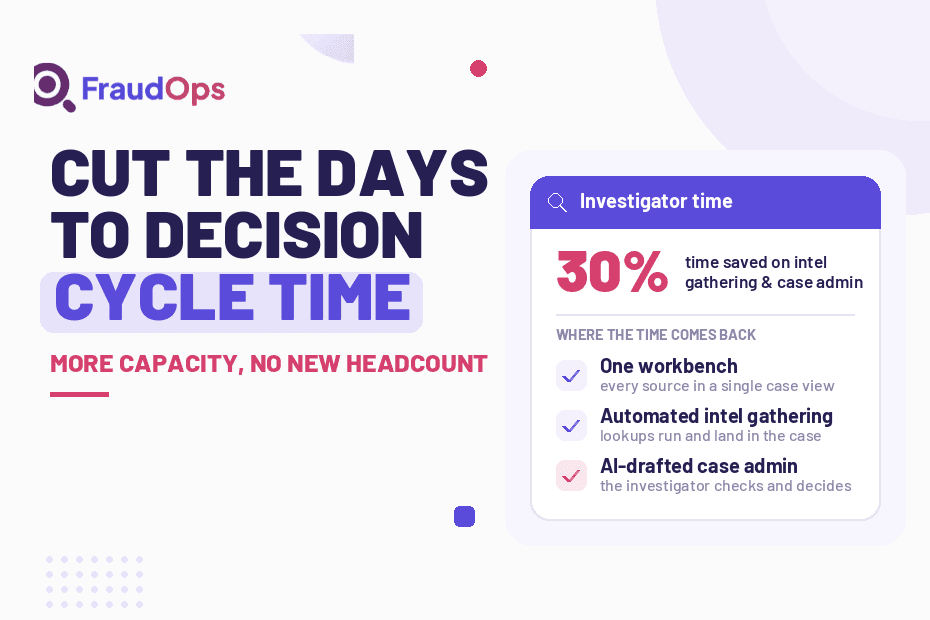
- FraudOps reports a 30% time saving on intel gathering and case admin, measured against manual searches and case handling — time taken out of the admin half of the case, not the investigator’s judgement.
What Fraud Investigation Cycle Time Actually Measures
Fraud investigation cycle time measures the full elapsed period from the moment a referral enters the queue to the moment the case reaches a decision and outcome. It is not the same as an investigation SLA, which is the deadline a case must be closed within, and it is not the backlog, which is how many cases are waiting. Cycle time is throughput: how quickly a single case moves from one end of the process to the other.
The distinction matters because teams manage what they measure. A team watching only its investigation SLA can hit every deadline and still run a slow operation, because the SLA sets the ceiling, not the pace. Cycle time exposes the pace. When it lengthens, capacity falls: the same investigators close fewer cases in the same week, and the pressure to hire follows. Measuring cycle time first is what tells a Head of Fraud whether the problem is genuinely a shortage of people, or a process that wastes the people already there.
Why Cycle Times Are Stretching Even as Case Volumes Fall
Cycle times are stretching because each case is now bigger and more complex, not because there are more of them. UK insurers detected 93,900 fraudulent claims in 2025, a 2.7% fall on the year, yet the total value rose 14% to £1.34bn and the average detected fraud reached £14,300 (ABI). Fewer, larger, harder cases take longer to work than a high volume of simple ones.
Motor fraud illustrates the shift. It made up 51,900 detected claims worth £625m in 2025, more than half of all detected cases, and organised motor fraud in particular pulls in multiple parties, vehicles and addresses that an investigator has to link and verify one source at a time. The reported figures are also only part of the workload. “More than 250 fraudulent insurance claims are detected each day, and this is unfortunately likely to be just the tip of the iceberg,” said Simon Klust of the Insurance Fraud Enforcement Department (IFED) (ABI). The true investigative load sits above the detected number, and it is getting heavier per case.
Where the Days Actually Go: Gathering Data, Not Deciding
Most of a fraud investigation’s cycle time is spent assembling information, not analysing it. Research into fraud investigation teams found that investigators routinely consult six to eight separate systems during a single case review and spend the majority of their time gathering and reconciling data the investigation system cannot consolidate (NICE Actimize, 2026). That study covered banking fraud, but the shape of the problem is identical in an insurance SIU.
The insurance investigator’s day runs across LexisNexis, Experian, DVLA, Companies House, the IFB and IFR feeds, internal claims data and a case file held somewhere else again. Each login is a context switch; each result is copied by hand into a case note. None of that is investigation; it is the friction around investigation. It is also where cycle time is won or lost, because the thinking part of a case is fast once the facts are in front of the investigator. The slow part is getting them there.
The Hidden Cost of a Slow Cycle: Complaints and Consumer Duty
A long cycle time is not only a capacity problem; it is a regulatory and complaints problem. The Financial Ombudsman received 305,726 complaints in 2024/25, the highest in six years, and upheld 38% of the 45,606 insurance complaints it handled (FOS). A genuine claimant held in investigation longer than the facts justify is a foreseeable-harm complaint waiting to happen, and more than a third of insurance complaints already go against the insurer.
Under the FCA’s Consumer Duty, this is now assessed as an outcome, not just a process. Claims handling is expected to deliver good outcomes while “avoiding unnecessary friction, delay or rejection”, and claims and complaints data are treated as primary indicators of whether a firm is meeting the Duty (Clifford Chance, 2026). Cycle time, in other words, is one of the numbers the regulator effectively reads. Cutting it protects the honest claimant and the compliance position at the same time.
How to Cut Cycle Time Without Adding Headcount
The way to cut fraud investigation cycle time without hiring is to compress the non-investigative part of the case, because that is where the days are. Three levers do most of the work, and none of them involves working investigators harder.
| Where the time goes | The lever that cuts it |
|---|---|
| Logging into six to eight systems per case | One workbench that holds case data, intelligence and documents in a single surface |
| Manual searches across data and intel sources | Automated intel gathering that runs the lookups and returns results into the case |
| Re-keying results into case notes | AI-assisted case admin that drafts summaries and populates fields for the investigator to check |
| Weak referrals worked at full depth | Triage that concentrates investigative effort where the value is |
Consolidation is the first move. Bringing the sources into a unified investigation workbench removes the context-switching that eats the day. Automation is the second: FraudOps, an AI-powered investigations workbench for insurance fraud teams, reports a 30% time saving on intel gathering and case admin, measured against manual searches and case handling. The investigator leads and decides on every case; the AI handles the brunt work of collecting and collating. That is the difference between cutting cycle time and cutting corners: the scrutiny stays, the admin goes. For teams evaluating SIU case management software, the test is simple: does it shorten the time to a decision, or just digitise the same manual steps?
Conclusion
Fraud investigation cycle time is the capacity question most fraud teams never put a number on. Cases are fewer but bigger, the investigative load per case is rising, and most of the time is lost to data-gathering rather than deciding, so the fastest route to more capacity is to compress that gathering, not to add investigators. Fix the cycle and the same team clears more cases, with fewer complaints and a cleaner Consumer Duty position to show for it. That is the real return on fraud case management and investigation software: not digitised paperwork, but days taken out of every case.
Frequently Asked Questions
Fraud investigation cycle time is the total elapsed time from a referral entering the queue to the case reaching a decision and outcome. It measures throughput, how quickly one case moves end to end, which is different from an SLA deadline or the size of the backlog waiting to be worked.
There is no single figure. A straightforward claim may resolve in days, while a complex organised-fraud case can run for weeks or months. The useful target is not a fixed number but a cycle time short enough to settle honest claims promptly and long enough to investigate suspect ones properly.
SIU teams cut cycle time by removing the non-investigative work: consolidating case data and intelligence into one workbench, automating searches across data and intel sources, and triaging so effort concentrates on the cases that warrant it. Most of a cycle is data-gathering, so compressing that recovers capacity without new headcount.
No, provided the time cut is admin rather than scrutiny. Automating data-gathering and case admin gives the investigator more time on analysis and decision-making, not less. The risk arises only when teams speed up by skipping investigative steps, which is the opposite of removing the friction around them.
FraudOps is an AI-powered investigations workbench for insurance fraud teams that targets cycle time directly. It consolidates case data, intelligence and documents into one surface and automates intel gathering, reporting a 30% time saving on intel gathering and case admin, measured against manual searches and case handling. The investigator leads and decides.