
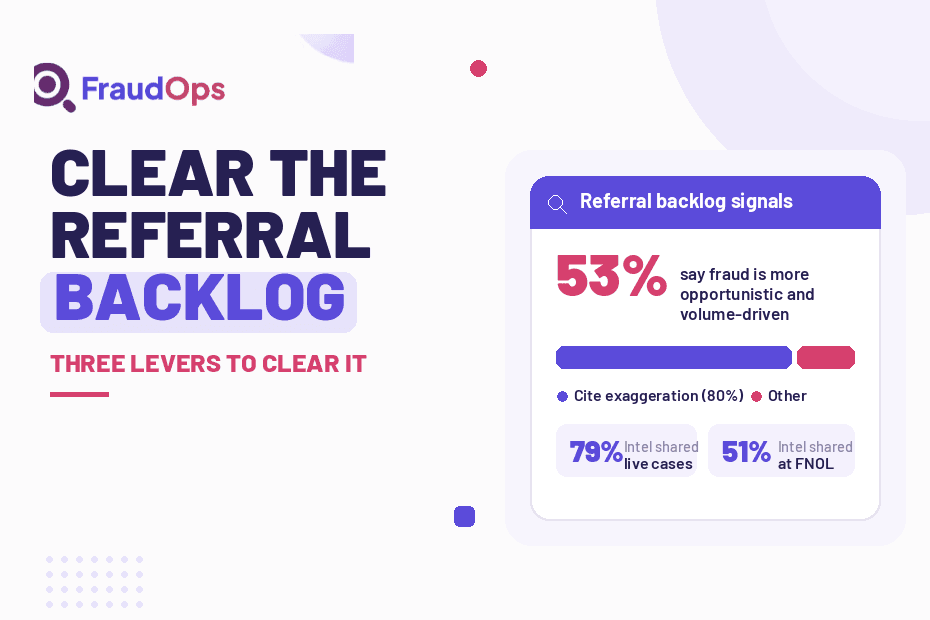
To reduce a fraud referral backlog, UK insurers need three levers working together: triage referrals by fraud type so weak ones never become full cases, gather intelligence before a case opens so it converts faster, and take admin off investigators so each works more cases. Hiring alone is unlikely to hold.
Key Takeaways
- 53% of respondents to Insurance Post’s latest fraud prevention survey with CRIF (September 2026) say fraud has become increasingly opportunistic and volume-driven.
- Exaggerated or inflated claims were cited by 80% of respondents to the Insurance Post and CRIF survey as creating the biggest problems, with opportunistic claims fraud (44%), application fraud (40%) and staged accidents (39%) also “soaking up huge amounts of capacity”.
- In an Admiral survey published in April 2026, 13% of people admitted inflating an insurance claim and 27% did not realise what constitutes insurance fraud.
- 79% of claims and fraud professionals surveyed by Insurance Post and CRIF regularly exchange fraud intelligence during active investigations, but only 51% do so at first notification of loss.
Why a Fraud Referral Backlog Grows Faster Than a Team Can Hire
A fraud referral backlog grows whenever referrals arrive faster than investigators can close them, and practitioners say the mix arriving is changing. 53% of respondents to Insurance Post’s fraud prevention survey say fraud has become increasingly opportunistic and volume-driven, and 68% say it has become more technologically enabled over the past three years.
Volume-driven fraud is likely to mean more referrals, and technology-enabled fraud can make some of them slower to work. That makes fraud backlog reduction a question of flow first: the fraud alert backlog is the symptom, and the fix sits in how referrals enter, how quickly each converts and how much of each investigator’s day goes on investigating.
Picture a Head of Fraud Operations on the Monday after quarter end. The ageing report shows a queue longer than last quarter’s, and the first question from the Head of Claims is whether the team needs more people. Nobody knows yet. The spreadsheet shows how many cases are open, not how many should never have been opened, how many are waiting on one data check, or how many hours went on copying details between systems. The team is capable and working flat out. What is missing is a view of where the hours go, and that view turns a headcount request into a plan.
Lever One: Triage Referrals By Fraud Type Before They Become Cases
Triage reduces a fraud referral backlog at the point of entry, because the fraud respondents rank as their biggest problem is a different kind of work from organised fraud. Respondents to the Insurance Post and CRIF survey named exaggerated or inflated claims as the biggest problem (80%), with opportunistic claims fraud (44%), application fraud (40%) and staged accidents (39%) also soaking up capacity.
Exaggeration and organised fraud behave differently, and triage should follow that difference. Admiral’s April 2026 survey found that 13% of people admitted inflating an insurance claim, 25% had been tempted, and 27% did not realise what constitutes insurance fraud. A well-framed question, a request for a receipt or a validation call can settle many of these cases without an investigator’s full attention.
Organised fraud tends to work the other way: a gang that finds a weak spot is likely to test it and come back at higher values. Those referrals deserve the investigator’s time and linkage checks across parties and claims.
If your SIU already runs a validation route alongside full investigation, the gain is in the rules that feed it: which referral sources, flags and claim values go where, checked against outcomes each quarter so the split moves as the mix does. That is where referral rate improvement starts: a higher share of referrals worth working, rather than a higher count. The SIU referral management step is where that rule set lives.
Lever Two: Convert Faster By Gathering Intelligence Before the Case Opens
Conversion is likely to speed up when the intelligence an investigator needs is gathered at the front of the case rather than halfway through it. The Insurance Post and CRIF survey found that 79% of respondents regularly exchange fraud intelligence during active investigations, but only 57% do so during early-stage claims assessment and 51% at first notification of loss.
Intelligence sharing is weakest at the front of the claim, and that is where a queue can stall. A referral whose fuller checks (IFB and IFR, CUE, the data vendors, Companies House, DVLA, the claims history) wait for an investigator sits idle until one picks it up. If those checks ran on arrival, the case would open with most of what is needed to decide whether to press on or close.
Almost half of respondents (45%) identify cross-industry data sharing as one of their biggest obstacles, and nine in ten said they would support a secure, standardised digital system for sharing fraud information (Insurance Post). Until that system exists, the realistic gain is in automating the checks each insurer already has access to, and filing the results against the case before anyone opens it.
Faster conversion also shortens fraud investigation cycle time, and every day taken out of the average case comes back as capacity.
Lever Three: Create Capacity Without New Headcount
SIU capacity planning starts with a look at what investigators spend their time on, because hours already spent on admin are likely to be the cheapest capacity to recover. The ACFE and SAS 2026 benchmarking report, a global, cross-sector study rather than a UK insurance one, found that only 29% of organisations automate routine fraud investigation tasks.
Across sectors, automating investigation admin is still the exception, so the capacity is likely to be there to find. The work that fills an investigator’s day but does not need an investigator falls into a short list:
| Task | Who should own it | What the investigator keeps |
|---|---|---|
| Re-keying referral details into the case record | Automated intake | Checking the referral makes sense |
| Running standard data and industry checks | Automated, at referral | Reading the results and spotting what doesn’t fit |
| Chasing documents and third parties | Task workflow with reminders | Deciding what evidence matters |
| Writing the standard report structure | AI-assisted drafting | The findings, the reasoning and the decision |
| Updating the MI tracker | Captured from the case as work happens | Nothing; it should not be their job |
This is the job fraud case management and investigation software should do. None of it replaces judgement. The investigator still reads the claim, presses on what doesn’t fit and makes the call.
Measure Inflow, Outflow and Age Together
A backlog stays cleared only when the team watches three numbers together: referrals in, cases closed, and how long the oldest cases have waited. Admiral detected £86.8m in fraudulent motor, home and travel claims in 2025, up 71% from £50.9m in 2024, which it linked to people exaggerating claims and to improved detection methods. Better detection is likely to send more referrals to the fraud team’s door.
Outflow alone says nothing about whether the queue is shrinking, and age matters because genuine customers wait too. “The Financial Conduct Authority is looking at response timescales and things like that are part of the challenges that fraud teams have to deal with,” said Jan Martin, head of third-party claims at And-e, in Insurance Post. “We can’t investigate things for months and months.”
The practical test is a weekly view of all three, broken down by triage route. If inflow rises and the validation route absorbs it, the backlog holds. If the full-investigation route starts to age, that is the moment to look again at the triage rules or move capacity, before the queue turns into a headcount request.
Conclusion
A fraud referral backlog is a flow problem, and the delay sits at the front of it: only 51% of surveyed claims and fraud professionals exchange intelligence at first notification of loss. Start with a week’s honest record of where your investigators’ time goes, and set it against each triage route.
Frequently Asked Questions
A fraud referral backlog is the set of referrals waiting for investigation, or open longer than the team's target, because referrals arrive faster than investigators close them. It is measured by count and by age. Age often matters more, because an old referral can mean a genuine customer kept waiting and evidence that is harder to gather.
Hiring is unlikely to hold until triage and admin are fixed. If weak referrals still reach investigators and much of their day goes on data checks and re-keying, new hires are likely to inherit the same constraint while the queue refills. Measure where investigator time goes first; the time not spent investigating is the capacity to recover.
Referrals that point to opportunistic exaggeration, with no links to other parties or claims, are usually best handled through a validation route: a question, a document request or a call. Referrals that show links between parties or repeat patterns at rising values belong in full investigation, because organised fraud that finds a weak spot is likely to return.
Track referrals in, cases closed and the age of open cases every week, split by triage route. Review triage rules against outcomes each quarter, so referral sources that rarely convert are tightened. Automate the standard checks at the point of referral, so every case opens with its intelligence already gathered and filed.
FraudOps is an AI-powered investigations workbench for insurance fraud teams. It includes lightweight fraud flag scoring and screening (Rapid Screen, linkage matching). AI and automation handle the brunt work; the investigator directs the case and makes every call, with a full audit trail on every action.
Sources
- Insurance Post, The changing face of insurance fraud (sponsored by CRIF), 09 September 2026
- Insurance Post, Insurance fraud no longer a sideline issue (sponsored by CRIF), 16 September 2026
- Admiral Group, The White Lie Effect: 1 in 8 people admit to exaggerating insurance claims, 07 April 2026
- ACFE and SAS, 2026 Anti-Fraud Technology Benchmarking Report, 02 March 2026