
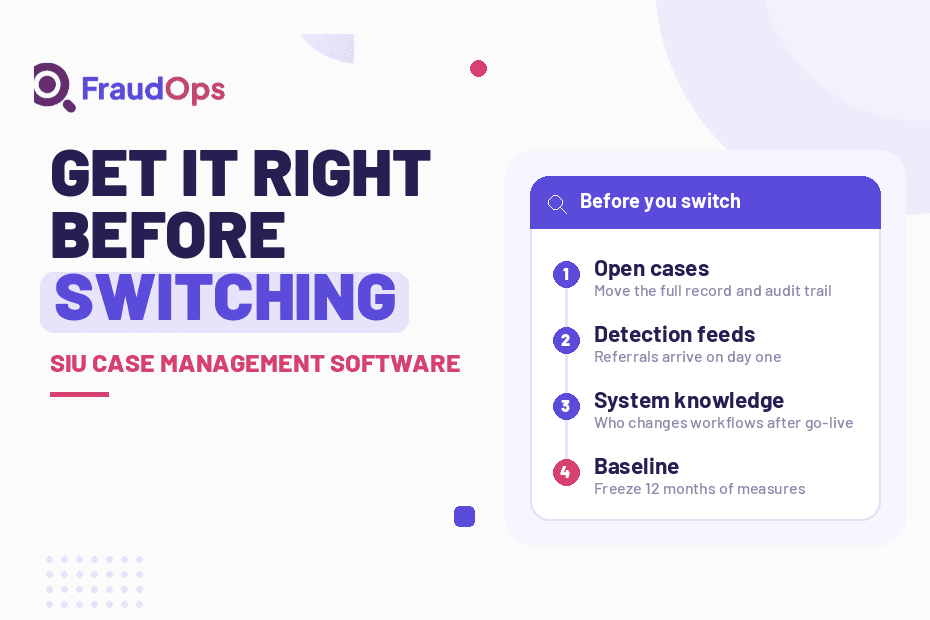
Before switching SIU case management software, a fraud team needs four things settled: how open cases and their history will move, how referrals from detection tools will arrive on day one, what the team will understand about the new system once it is live, and the baseline figures the switch will be judged against.
Key Takeaways
- Around 80% of insurers remain concerned about the quality of data feeding their AI models, according to Earnix’s Insurance 2026: AI Trends Bulletin.
- More than half (52%) of respondents to Insurance Post’s latest fraud prevention survey with CRIF use “AI-driven” fraud detection tools, so a new case system inherits those referral feeds.
- Globally, P&C insurers commit 72% of their AI investment to technology and infrastructure and 28% to change management, according to Capgemini’s World Property and Casualty Insurance Report 2026.
Picture a Head of Fraud three months into choosing a new case management system. The demos went well and the shortlist is down to two. Then the questions start arriving from other directions. Legal wants to know where years of closed-case notes will live. The claims director asks whether referrals will keep flowing during cutover. IT asks who will understand the configuration once the vendor’s project team has gone. None of it was in the demo script, and each answer decides whether the switch lands in a quarter or drags into next year. The Head of Fraud knows the team’s work better than any vendor. What helps is settling these questions on paper, in order, before anything is signed, so the decision rests on how the team will work in month two.
Why Switching SIU Case Management Software Stalls Before Go-Live
For many teams switching SIU case management software, the harder questions are integration and legacy systems rather than features. When the Bank of England and FCA surveyed UK financial firms in 2026, the most cited non-regulatory constraints on AI were integrating it into existing business processes and decisions, and the limits imposed by legacy systems or infrastructure, named as large constraints by 23% and 22% of respondents respectively. The same survey found third-party implementations made up 53% of high-materiality AI systems, up from 35% in 2024, and that for third-party systems 81% of respondents relied on vendor assurance and contractual arrangements, while only 24% reported deep knowledge of them. The survey covers AI across financial services, not fraud case management, but an AI-powered case system bought from a vendor raises the same integration and vendor-knowledge questions.
For a fraud team changing fraud case management systems, that shifts where the evaluation effort should go. Feature comparison is the easy part of selection. The harder part is the integration map for your own estate: the detection tools, data vendors, industry fraud feeds and core claims system that feed or receive from the case record. Ask each vendor to walk that map with your sources named, and to say who changes a workflow, a checklist or a referral rule after go-live. If the answer is always “raise a change request”, the team will know less about its own system in year two than it does about the current one. Ask the outgoing vendor the same question in reverse: how the case data will be extracted, in what format and on what terms.
Open Cases and Their History Decide the Migration Plan
Open cases set the SIU case management migration plan, because a fraud case can stay live, or come back, long after the claim that started it. Paul Waring, director of IT and CISO at Blagrove Underwriting Agency, described the constraint in Insurance Business: “Claims can go on for years and years, and they can come in five years after a policy’s ended.” Waring was speaking about claims data in general, but SIU case files can carry the same long tail, since litigation, recoveries and reopened referrals may arrive well after closure.
Data quality makes the job harder. Around 80% of insurers remain concerned about the quality of data feeding their AI models, according to Earnix’s Insurance 2026: AI Trends Bulletin, which drew on 40 UK insurance leaders within a wider survey of more than 400 global executives, as reported by Insurance Business. That figure is about AI inputs, but moving poor data into a new system only moves the problem, so cleansing belongs before migration.
A workable approach is to split the case book three ways and agree the treatment for each before contract signature:
| Case group | What moves | Why it matters |
|---|---|---|
| Live cases | Full record: timeline, tasks, evidence, intel results, notes and the audit trail of who did what | Investigators cannot pick up a case mid-flight from a status field alone |
| Recently closed cases | Outcome, decision rationale and supporting evidence, within your own reopen and challenge window | Decisions still open to challenge need their reasoning intact |
| Older closed cases | Parties, entities and outcomes, archived read-only and searchable | Linkage across old and new cases depends on this history staying searchable |
One detail that is easy to miss is the history behind a decision. A migrated case that shows “closed, repudiated” without the steps behind it cannot defend that decision later, which is why the audit trail behind each investigation needs to travel with the case.
Referrals From the Detection Stack Have To Arrive On Day One
The new system has to receive referrals from the detection stack from its first day, because the queue does not pause for a migration. More than half (52%) of respondents to Insurance Post’s latest fraud prevention survey with CRIF, published in September 2026, use “AI-driven” fraud detection tools, and every scored alert from those tools needs a route into a case, with its score and reasons attached, so the investigator can see why the claim was flagged.
Three decisions keep the cutover clean. First, a single cut-off date: new referrals open in the new system from that date, and nothing is keyed into both. Second, a test using a real week of referral volume, including the awkward ones (duplicates, linked parties, referrals that arrive by email rather than feed). Third, a short list of what the detection tool sends back, because outcomes recorded in the case system are what let detection rules improve. Detection tells the team where to look; the investigation layer that works alongside detection is where the case is worked and the result recorded.
The Team and the Baseline Need Budget Alongside the Licence
The people side of a case management implementation, and the figures that will judge it, need their own budget and plan. Capgemini’s World Property and Casualty Insurance Report 2026, a global study, found P&C insurers commit 72% of their AI investments to technology and infrastructure, with only 28% to change management. That figure is about AI spending rather than case management projects, but the pattern is familiar to anyone who has watched a new tool arrive with a licence fee and a two-hour training session.
For a fraud team, change management is practical. The investigators who carry the heaviest caseloads should shape the case templates, checklists and report formats, because they will spot what breaks first. Intel analysts need their searches, watchlists and linked-case views rebuilt before go-live, not after. Every user needs a clear answer to where a given piece of work now happens.
The baseline matters as much. Before the old system is switched off, take twelve months of the measures the switch will be judged on, such as referral rate, referral-to-outcome conversion, cycle time, cases per investigator and SLA breaches, and freeze the definitions. Once the old data is archived, rebuilding a like-for-like comparison is slow and contested, and the board will ask for one. Good SIU case management software makes those measures visible from the first week; the baseline is what gives them meaning.
Conclusion
A switch of fraud case management and investigation software succeeds or fails on decisions made before contract signature: which cases move and with what history, how detection referrals arrive on day one, what the team will know about the new system, and which figures it will be judged on. Settle those on paper with named owners, and the selection becomes a choice about how the team works rather than which demo impressed most.
Frequently Asked Questions
Split them. Recently closed cases still open to challenge or reopening should move with their outcome, decision rationale and evidence. Older closed cases can sit in a read-only, searchable archive, provided parties and entities stay searchable so linkage between new referrals and past cases still works. Agree the cut-off with legal and claims before migration starts.
Only as long as your governance requires. Set a single cut-off date after which every new referral opens in the new system, and finish or migrate live cases from the old one. Long parallel running creates double keying, two versions of the truth and confusion about where work happens. A short read-only period for the old system can cover lookups.
Ask them to walk through your own integration map: each detection tool, data vendor, industry fraud feed and the core claims system, with what flows in and what flows back. Ask who changes workflows and referral rules after go-live, how long a typical change takes and how referral scores and reasons appear on the case.
SIU case management software is the system a special investigation unit uses to work referred cases: it holds the case record, tasks, evidence, intelligence results and decisions, with an audit trail of every action. It sits downstream of detection tools, which flag suspicious claims, and turns those referrals into worked cases with recorded outcomes.
FraudOps goes live in under 4 weeks for a Tier 1 insurer; days for a TPA. For any switch, settling the integration map and the scope of case history to migrate early keeps the project on schedule. The investigator leads and decides on every case.
Sources
- Bank of England and FCA, Artificial intelligence in UK financial services – 2026, 26 October 2026
- Insurance Business, The $200 billion problem sitting under UK insurance transformation, 06 October 2026
- Insurance Business (reporting Earnix, Insurance 2026: AI Trends Bulletin), Majority of UK insurers now running AI in core functions but execution gap widens – report, 14 June 2026
- Insurance Post, The changing face of insurance fraud, 09 September 2026
- Capgemini, The moment of AI truth for property & casualty insurance, 05 May 2026