
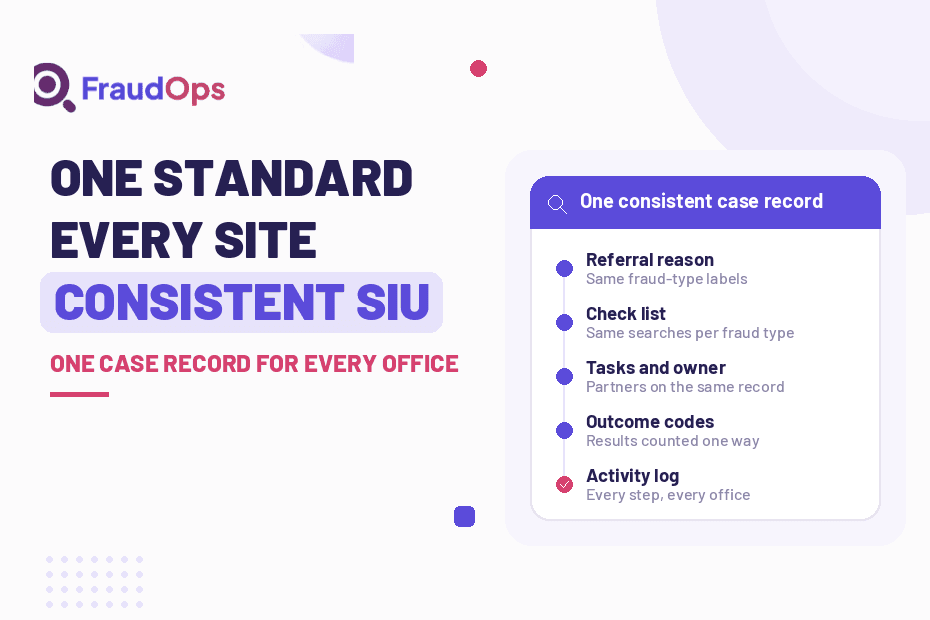
Consistent SIU case management means two investigators in different offices, or an in-house team and an outsourced partner, work the same type of referral to the same standard and record it the same way. It rests on a shared case record, common checks for each fraud type and management information that compares like with like.
Key Takeaways
- Ecclesiastical’s fraud detection rate rose from 8.3% in 2024 to 13.8% in 2025, which the insurer attributes to continued investment in the training and development of its staff.
- 49% of respondents to Insurance Post’s latest fraud prevention survey with CRIF, published September 2026, named technology limitations and resource constraints as the greatest barriers to tackling fraud.
- Between 40% and 44% of UK working adults now work remotely or on a hybrid pattern, according to MyPerfectCV’s UK Remote Work Report 2026.
- In the ACFE and SAS 2026 global benchmarking survey, 38% of organisations named poor data quality or integration as a major challenge in implementing new anti-fraud technology.
Why Consistency Breaks When an SIU Works Across Sites
Consistency tends to break across sites because each office, and each investigator working from home, gradually builds its own habits around a shared policy. Nobody decides to diverge. A checklist gets a local addition, a team lead prefers a certain report layout, one site asks for bank statements earlier than another.
The structure of the team does not settle this on its own. Capable UK insurers have reached different answers. According to Insurance Post, Ageas brought its fraud teams together into one fraud centre about 18 months before November 2025, Markerstudy runs a centralised counter fraud team, Allianz takes a centralised approach, and at Aviva fraud experts sit within both underwriting and claims. Each model has its reasons. Each still has to make a referral handled on Monday in one place look like a referral handled on Thursday in another.
Geography has also loosened. Between 40% and 44% of UK working adults now work remotely or hybrid, and around 14% fully remotely (Workplace Journal, reporting MyPerfectCV). That figure covers all UK workers, not fraud teams. For distributed fraud investigation teams, the “office” is a set of people working from different places, and the corridor conversation that used to keep practice aligned happens less often.
Picture a Head of Fraud two days before the quarterly review. The northern team is converting escape-of-water referrals at a noticeably higher rate than the southern team, and the board will ask why. Is the north better at spotting fraud, harder on genuine customers, or simply recording outcomes differently? The answer sits in two spreadsheets and the memory of a team lead who is on leave. The Head of Fraud knows both teams are good. What they lack is a way to show it. Now picture the same review with every case on one record, carrying the same checks and outcome codes for that claim type. The difference between the teams becomes a question about cases and judgement, which is a conversation worth having. Seeing workload by investigator and site is part of the same picture.
Inconsistent Handling Shows Up As an Outlier Against Peers
Inconsistent handling can become visible as an outcome that looks out of line with comparable teams or firms, before anyone reads the files. The FCA gave a clear example in its December 2025 response to the Which? super-complaint. One insurer had higher rates of claims rejections, walkaways and complaints than its peers. The FCA found that the insurer’s outsourced claims handler had been responsible for issues in claims handling, and that there were weaknesses in the insurer’s oversight arrangements. The insurer committed to enhancing internal management information and key performance indicators for claims handling, and all key claims handling metrics then showed significant improvement. That case concerned claims handling in general rather than fraud investigation, but the mechanism is the same one an SIU faces.
In a multi-office SIU, a site-level outlier can only be spotted if the sites record the same things in the same way: outcome by claim type, time to first action, referrals closed with no further action, declines later reversed. Without that, an outlier looks like noise.
Outsourced work can widen the gap: field investigators, surveillance firms and panel solicitors may each return work in their own formats and on their own timetables, while the principal still owns the outcome. Darren Betts, head of risk and regulation at Sedgwick International, describes outsourced claims administration as moving from a cost-and-capacity model to a governance-and-control model, with principals expected to evidence oversight of outcomes even where delivery sits with TPAs (Insurance Business). For an SIU, that means the partner’s work belongs on the same case record as the in-house team’s, against the same tasks and dates.
Training Sets the Standard and the Case Record Keeps It
Training is what sets a common standard of judgement, and the evidence that it moves results is specific. Ecclesiastical’s claims team investigated over 280 cases of suspected fraud in 2025, a 20% increase on 2024, and its fraud detection rate rose from 8.3% to 13.8%, which the insurer credits to continued investment in the training and development of its staff (Ecclesiastical).
Training alone has a half-life, though. People learn the standard in a classroom and then apply it in whatever tools their site happens to use. Where those tools differ, the standard drifts with them.
The UK market is not short of the basics. Insurance Post’s survey with CRIF found that training programmes, intelligence partnerships and specialist fraud teams are now firmly established across the market, and that 49% of respondents cite technology limitations and resource constraints as the greatest barriers to tackling fraud (Insurance Post). Read together, the two findings put the gap between what a trained investigator knows to do and what the tooling makes easy to do the same way every time.
What a Consistent SIU Case Record Holds
A consistent case record holds the same fields, checks and outcome codes for every case of a given type, wherever and by whoever it is worked. Data is also where new anti-fraud technology tends to run into trouble. In the ACFE and SAS 2026 Anti-Fraud Technology Benchmarking Report, a global survey of 713 anti-fraud professionals across sectors, 38% of organisations named poor data quality or integration as a major challenge in implementing new anti-fraud technology.
| Element | What it standardises | What drifts without it |
|---|---|---|
| Referral reason and fraud type | How a case enters the queue | Similar cases filed under different labels |
| Check list per fraud type | Which searches and documents are expected | One site checks more than another |
| Task dates and owner | Who does what, and when | Partners’ work tracked by email |
| Outcome codes | How a result is recorded | Savings and declines counted differently |
| Activity log | What was done, by whom, and why | Decisions that cannot be explained later |
The last row matters most when a decision is challenged. An audit trail for fraud investigations shows the steps behind a decision, whichever office took it.
AI can help hold the method steady, provided the investigator stays in charge of the call. Pete Ward, head of claims counter-fraud at Aviva, put it this way to Insurance Post: “What Gen AI ultimately does is it introduces a consistency of method and is an aid to support our front-line teams.” That is the useful framing for fraud case management and investigation software: the same intel gathered the same way on every case, so the differences that remain are differences of judgement.
Conclusion
Consistency across offices, home workers and outsourced partners comes from training people to one standard and then giving them one case record that keeps them there. When checks and outcome codes match, an outlier between sites becomes a question a Head of Fraud can answer with evidence. If your teams record differently today, begin SIU case management standardisation with the outcome codes: they are often the simplest place to start, and the one the board will notice. For teams weighing SIU case management software, this is a fair test to put to any product.
Frequently Asked Questions
Agree one check list for each fraud type, one set of outcome codes and one case record that every office uses, including home workers. Then report outcomes by site and claim type side by side. Differences that survive like-for-like comparison are worth reviewing case by case; differences caused by recording disappear once everyone records the same way.
Both models are in use at large UK insurers. Ageas moved its fraud teams into one fraud centre and Markerstudy and Allianz run centralised teams, while Aviva places fraud experts in underwriting and claims. Either way, the structure does not settle consistency on its own; a shared case record and common outcome codes do.
Compare like with like: the same claim type, a similar referral source and the same period. Useful measures include outcome by fraud type, time to first action, cases closed with no further action and declines later reversed. Read the gaps as prompts for case review rather than as league tables.
Put their work on the same case record as the in-house team's, with the same tasks, deadlines and outcome codes. Sedgwick's Darren Betts describes outsourced claims administration as moving towards a governance-and-control model, where principals evidence oversight of outcomes. That is far easier when partner reports arrive inside the case.
Yes, if it gives every investigator the same case record and does the repetitive gathering the same way each time. FraudOps, an AI-powered investigations workbench for insurance fraud teams, reports a 30% time saving on intel gathering and case admin, against manual searches and case handling. The investigator directs the case and makes every call.
Sources
- Financial Conduct Authority, Response to Which?’s super-complaint on addressing poor consumer outcomes in home and travel insurance, 18 December 2025
- Insurance Business, Claims oversight now a ‘decisive factor’ as regulators tighten scrutiny – Sedgwick, 08 September 2026
- Insurance Post, Spotlight: From siloed fraud teams to shared intelligence, 19 November 2025
- Ecclesiastical, Claims team cracks down on fraudsters, 09 February 2026
- Insurance Post, The changing face of insurance fraud, 09 September 2026
- Workplace Journal (reporting MyPerfectCV’s UK Remote Work Report 2026), Up to 44% of UK workers now in remote or hybrid roles, report finds, 24 March 2026
- ACFE and SAS, 2026 Anti-Fraud Technology Benchmarking Report, 2026 (survey fielded October 2025)