
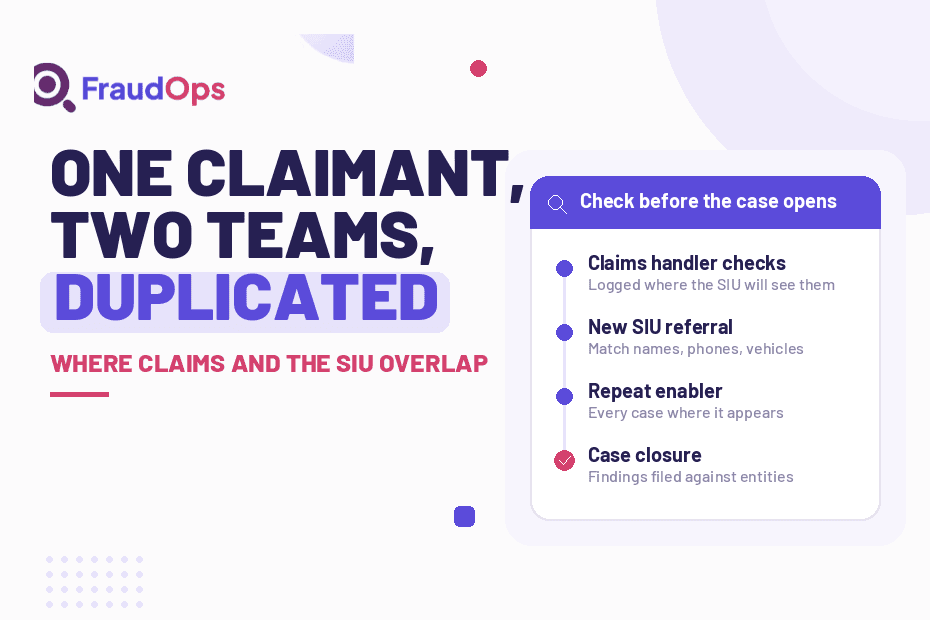
Duplicate fraud investigation work happens when two teams in the same insurer, usually claims and the SIU, check the same claimant, vehicle, garage or other enabler without knowing the other has done it. Each team searches and decides alone. The cost is wasted effort, conflicting decisions and a pattern nobody sees whole.
Key Takeaways
- A garage trading as Tyre Boys Ltd had 39 cases funded by a finance provider, worth £275,548.84, and some of those claims had been flagged as fraudulent by insurers; two men were jailed for a combined total of more than nine years in May 2026.
- Allianz UK identified more than 34,200 insurance fraud cases in 2025, and its fraud savings were equivalent to more than 650 cases a week.
- Aviva reports a growing number of claims involving a small number of unscrupulous loss assessors, the kind of repeat enabler that is easier to spot when claims are seen together.
- A Liverpool claimant, convicted in August 2026 according to Weightmans, made thirty separate fraudulent pet insurance claims, extracting over £31,000 from multiple insurers before IFED intercepted the pattern.
Why Duplicate Fraud Investigation Work Starts Inside the Insurer
Duplicate fraud investigation work starts inside the insurer because claims handlers, underwriting and the SIU each run their own checks on the same people, and those checks often sit in separate systems. A claims handler with a doubt runs searches, underwriting screens at inception, and the SIU starts again on referral.
The volume makes memory useless as a control. Allianz UK identified more than 34,200 insurance fraud cases in 2025, and its fraud savings for the year were equivalent to more than 650 fraud cases a week. At that rate, no team can rely on someone remembering that a name, a phone number or a hire company came up last month on another desk.
Practitioners name the problem directly. Weightmans’ November 2026 review of insurance fraud calls for “breaking internal silos between underwriting, claims, and special investigation units (SIUs)”. The silo often comes down to systems rather than goodwill: each team keeps its own record of what it checked.
Picture an investigator on a Wednesday morning. A credit-hire referral lands in her queue. She runs the usual searches and starts building the case. By mid-afternoon she has a working theory about the repair garage. Then a colleague in motor claims mentions, in passing, that his team queried a claim through the same garage six weeks ago and wrote a full note on it. Half of what she found already existed, in a different system. With that note on the referral when it landed, she would have started at the garage.
Organised Fraud Spreads Across Claims That Look Unrelated
Organised fraud tends to spread across claims that look unrelated, because a route that pays is reused: the same enablers, addresses and suppliers can sit behind different claimants. That reuse is the signal, and it is only visible when claims are seen together.
The pattern shows up in insurers’ own data. On property claims, Aviva reports a growing number of claims involving a small number of unscrupulous loss assessors, and a growing role for professional enablers who attach themselves to claims.
The Tyre Boys case shows one enabler behind dozens of claims. Between December 2015 and October 2016, Accident Credit Group funded 39 cases for a garage trading as Tyre Boys Ltd, totalling £275,548.84. According to the police statement, the collisions behind them were either deliberately induced or had never taken place.
Commenting on Zurich’s figures, Vishal Marria, founder and chief executive of Quantexa, said: “Fraud hides in the gaps between claims, which is why seeing the full context matters.” Detection tools can link claims at intake. The gap that remains is inside the investigation: whether the SIU’s case record knows what the claims team has already found. The network link analysis piece covers how those links are traced once a case is open.
Serial Claimants Rely On Each Claim Being Judged Alone
Serial claimants rely on each claim being judged alone, because often no single claim looks unusual enough to escalate. The serial claimant is a different type from the opportunist who pads a single claim: the serial claimant repeats a method that has worked.
Weightmans records a Liverpool claimant convicted of fraud by false representation after submitting thirty separate fraudulent pet insurance claims. The claimant repeatedly took out new policies and, shortly afterwards, claimed the insured dogs had died, extracting over £31,000 from multiple insurers before IFED intercepted the pattern.
Group structure adds more places for the same claimant to appear. Aviva’s 2025 fraud figures include Direct Line brands for the first time, following its acquisition of Direct Line in July 2025. Where books, brands and teams combine, a claimant already known to one claims team can arrive as an unknown at another, unless the two teams share a case record.
What Duplicated Work Costs When the Pattern Lives Outside the Case
Duplicated work costs a fraud team more than the hours of repeat investigation effort: it lets the strongest evidence, the pattern across claims, sit somewhere no investigator is looking.
In the Tyre Boys case, the evidence sat with different holders. Insurers had flagged some of the claims as fraudulent, the finance provider was later alerted to those flags, and IFED opened a money laundering investigation after receiving intelligence about the company. Each held part of the picture, and cases funded between December 2015 and October 2016 reached sentencing in May 2026.
Inside a single insurer, the same split shows up in three ways. Searches are run twice, which matters wherever data vendor searches carry a cost. Decisions diverge: one team declines a claim through a garage while another pays a claim through the same garage. And the case the SIU eventually builds against a network is weaker than it could have been, because the earlier findings were never attached to it. Context lost in fraud case handoffs is what happens when one case moves between teams; this is the other half of the problem, where two cases never meet at all.
How To Stop Two Teams Working the Same Claimant
Stopping duplicate fraud investigation work comes down to checking for existing knowledge before a case opens, and making every team’s findings land on the same record. The evidence that a joined-up view finds more is strong: at Zurich UK, connected analytics identified 860 fraudulent claims worth £17.9m, around one in five of all the cases it detected in the past 12 months.
Assume the IFB and IFR checks and the detection tools linking claims at intake are already in place. The practical gaps sit at the points where work starts and ends:
| Where duplication starts | What to check before the case opens | What it prevents |
|---|---|---|
| A claims handler’s own fraud checks | That the searches and findings are logged where the SIU will see them on referral, and that an existing SIU interest shows as a flag, not the case detail | The SIU repeating searches the claims team ran last week |
| A new SIU referral | Matches on names, addresses, phones, vehicles and enablers across all live and closed cases, in every brand | Two investigators building separate cases on one network |
| A repeat enabler (garage, hire firm, loss assessor) | Every case where that enabler appears, and how each ended | Conflicting decisions on claims through the same supplier |
| Case closure | That findings are filed against the entities, not only the claim | Next month’s referral starting from nothing |
The common thread is the record. Fraud intelligence sharing between claims and the SIU works when findings are stored against people and entities, where the next search finds them, rather than in a claim note only its author will reopen. SIU claims collaboration then becomes routine: the investigator opens a referral and sees that the hire company has history before running a single search. That is the job good fraud case management and investigation software should do, alongside the detection tools already in place.
Conclusion
The public cases describe patterns across claims rather than one insurer’s teams duplicating each other, but the lesson carries: one garage behind 39 funded cases, one claimant behind thirty pet claims at several insurers. Patterns like these only show when claims are seen together. The fix is unglamorous: check every new referral against what every team already knows, and file findings against people and entities, where the next investigator will find them.
Frequently Asked Questions
Separate systems and separate records. Claims handlers run their own checks on a doubtful claim, underwriting screens at inception and the SIU starts again on referral. Unless findings are stored against the people and entities involved, each team sees only its own work, and the same claimant or supplier gets checked twice.
Look for repeat searches on the same names, claims through the same garage or hire company with different outcomes, and investigators learning of a colleague’s findings in conversation rather than from the case. Matching a month of closed cases against each other shows how often it happens.
It can, if sharing is unmanaged. Agree the purpose, fraud prevention, and give access on a need-to-know basis: record why each team can see each finding, restrict sensitive intelligence to investigators and keep an audit trail of who viewed what. Have your data protection officer approve the model before rolling it out.
Because a route that pays tends to be reused. A willing garage, hire firm or loss assessor is valuable to a group, so the same names can recur across claims with different claimants, which is what joined-up case records catch.
FraudOps can help. It includes lightweight fraud flag scoring and screening (Rapid Screen, linkage matching). It is screening, not a detection replacement: it works alongside your detection tools, and the investigator leads and decides on every case. The rest of the answer sits in the case record: findings filed where every team can see them.
Sources
- City of London Police via Insurance Business, Two jailed for more than nine years over motor insurance fraud: London police, 09 June 2026 (secondary-verified via Insurance Business)
- Allianz UK, Allianz UK prevents record level of fraud, 12 March 2026
- Aviva plc, Aviva stops record levels of claims fraud as scams become more sophisticated, 08 June 2026
- Weightmans LLP, Insurance fraud in 2026: emerging threats, regulation and enforcement, 11 November 2026
- Zurich UK via Insurance Business, Zurich uncovers record £109 million of fraud as gangs turn to AI, 05 November 2026 (secondary-verified via Insurance Business)
- Insurance Edge, Latest Claims Fraud Data From Zurich, 06 November 2026