
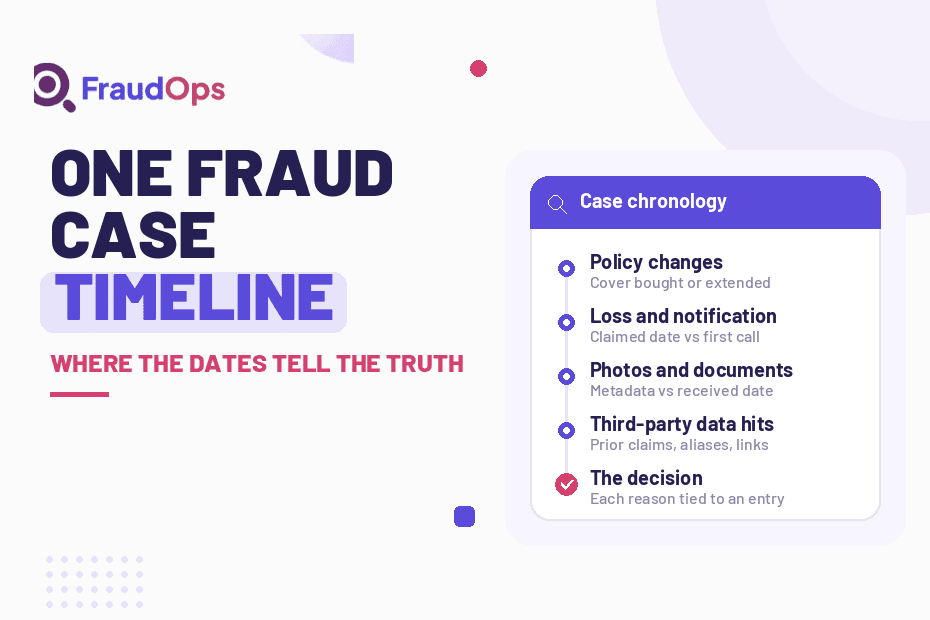
A fraud case timeline is the single, dated chronology of a claim: policy inception and changes, the loss, notification, calls, documents and third-party data hits, each tied to its source. The timeline is where the claimant’s account and the record part company, and it is the record an investigator’s decision is defended on.
Key Takeaways
- Aviva says it is seeing a growing number of claims supported by AI-generated images and manipulated documents, which a dated chronology tests against everything else on file.
- Zurich UK’s connected analytics identified 860 fraudulent claims worth £17.9 million, about one in five of its detected cases, including claimants using aliases to hide previous claims.
- In Greening-Steer v Ainge, an injury claim valued at just under £5 million was dismissed in its entirety for fundamental dishonesty after covert surveillance contrasted with the claimant’s presentation at medical examinations.
Picture an investigator at 4pm on a Thursday, working a referred escape-of-water claim. The policy history is in the claims system, the notification call is a recording elsewhere, the photos came by email and the data checks sit in three portals. The question that matters, whether the damage happened before the cover started, only has an answer when the dates sit side by side, and building that view by hand means another evening in a spreadsheet. With the chronology assembled as the case is worked, the hour goes on the part no system can do: deciding which date tells the truth.
Why a Decline Rests on the Fraud Case Timeline
A decline rests on the fraud case timeline because the finding turns on what the claimant knew, and when, set against what they said. A 2026 Financial Ombudsman Service decision on a Direct Line policy covering a rental property shows the mechanics. The policyholder added a second property to his cover in February 2025 and reported a claim the next day. The metadata in his photographs showed they were taken before the property was added. He said his tenant told him about the leak in the evening, but the messages he supplied were sent in the morning. A boiler company had a record of his call about the leak from before the cover change. Deciding on the balance of probabilities, the ombudsman found he more likely than not knew the damage had already occurred, and did not uphold his complaint.
None of those facts was hidden. Each sat somewhere different: the photo files, the tenant’s messages, a third party’s call log and the policy change record. The finding came from putting them in order, which is why the case chronology in insurance fraud belongs in the file from day one, not reconstructed when a decline is challenged.
Where AI-Altered Evidence Meets the Rest of the Claim Timeline
A fabricated photo or document still has to fit the dates around it, and the claim timeline is where that test happens. Aviva said in June 2026 that it is seeing “a growing number of claims supported by AI‑generated images and manipulated documents”, with fraudsters using the tools “to fabricate accident scenes and damage imagery to support false or exaggerated claims”.
The investigator’s question is whether this evidence fits everything else on file. Aviva describes travel claims “sometimes supported by documentation submitted after the event that does not withstand detailed scrutiny”. Much of that scrutiny is chronological. In a claim timeline investigation, logging each document’s own date, its metadata date and its received date gives the investigator three dates to test against each other and against the claimant’s account.
Exaggeration Shows Up as Two Timelines That Disagree
In the exaggerated injury claims below, the decisive evidence was a second, independent timeline that ran against the claimant’s own. In Greening-Steer v Ainge, a claim valued at just under £5 million, the experts found the claimant had made a good recovery from all injury sequelae by approximately mid-2021. Keoghs reports that this view was supported by covert surveillance in stark contrast to his presentation at medical examinations, and that forensic analysis of disclosure showed he had returned to work in his refrigeration engineering business. Mr Justice Ritchie found him fundamentally dishonest and dismissed the claim in its entirety.
In Ayaz v Royal Sun Alliance, now Intact Insurance, the claimant attended medical examinations in a wheelchair after a February 2020 road traffic accident, the first of them in 2022. Surveillance showed him walking without the wheelchair, driving a Range Rover and carrying boxes. His schedule of loss totalled £661,000, and the insurer’s application for summary judgment succeeded.
Both outcomes depended on dates set next to each other: the examination, the reported symptoms and the surveillance day. An investigator who logs each as a dated entry on one chronology hands counsel that comparison already made.
Organised Fraud Needs a Timeline That Runs Across Claims
Organised fraud can sit between claims, so the timeline has to run across linked claims, parties and locations as well as within one file. Zurich UK says its connected AI and advanced analytics identified 860 fraudulent claims worth £17.9 million, about one in five of the cases it detected, by linking each claim with information from Companies House, Equifax, industry intelligence and the Insurance Fraud Register, as reported by Insurance Business. Its examples include claimants using aliases to hide previous claims and several apparently unrelated claims linked to the same accident location.
“Insurance fraud in the UK is becoming more sophisticated, more organised and increasingly technology-enabled,” said Scott Clayton, head of claims fraud at Zurich UK and chair of the Insurance Fraud Bureau.
Detection and linkage tools find the connections; the investigator turns them into a case that makes sense in sequence. One pattern worth testing for is a small claim that went through, followed by similar ones at higher values. That progression only shows when separate claims are read together in date order, with the shared people, vehicles and addresses marked on each entry.
How to Build an Investigation Timeline That Holds Up
An investigation timeline holds up when every entry carries its date, its source and the time it was recorded, so anyone reviewing the case can test it. The stakes are highest in the cases that go furthest, where a chronology that starts as working notes can end up in an evidence bundle.
| Entry | Usual source | What to record | What it can show |
|---|---|---|---|
| Policy inception and changes | Policy administration system | Date, change made, channel | Cover bought or extended shortly before a loss |
| Loss and notification | FNOL record, call recording | Claimed loss date; notification date and time | Delay, or an account that shifts between calls |
| Photos and documents | Claimant uploads, email | Document date, metadata date, received date | Evidence that predates or postdates what it shows |
| Third-party data hits | Data vendors, industry fraud databases | Search date, result, source | Prior claims, aliases, links to other parties |
| Investigator actions and decisions | Case system | Action, date, outcome, reason | The reasoning behind the decision, step by step |
Keep event time and recorded time apart: a photo’s capture date, the date it was emailed and the date it was filed are three facts, and the gaps between them can be the finding. Note what each entry rules out, so a reviewer can follow why a line of enquiry closed. And write the decline from the timeline, each reason pointing to a dated entry.
Keep the timeline distinct from the audit trail behind each investigation: the audit trail records who did what in the system, the timeline what happened to the claim. Building both inside one investigation case management tool saves reconciling them later. This is where fraud case management and investigation software earns its place: assembling the chronology as the work happens, so the investigator reads it rather than rebuilds it.
Conclusion
The cases above were decided on sequence: photos taken before cover started, a recovery that predated the symptoms reported, claims that looked unrelated until they were put side by side. A fraud case timeline built entry by entry, with sources and recorded dates, is where those findings surface and the record they are defended on.
Frequently Asked Questions
Every dated event that bears on the claim: policy inception and changes, the loss, notification, calls, photos and documents, third-party data searches, and contact with garages, contractors or medical providers. Each entry should carry its source and the date it was recorded, so a reviewer can check it rather than trust it.
The audit trail records what people did in the system: who searched, viewed, changed or decided something, and when. The case timeline records what happened to the claim in the world. A defensible decision needs both, because they answer different questions when a decline is challenged.
A photo or invoice carries more than one date: the date it depicts, the date in its metadata and the date it reached the insurer. When those dates disagree with each other or with the claimant’s account, the investigator has a specific question to put to the claimant instead of a general suspicion.
Start from the shared entities: people, addresses, vehicles, phone numbers, repairers and accident locations. Put the linked claims on one chronology so the order is visible: which claim came first, what changed between them and whether the values rose. Claims that look like coincidence one at a time can read very differently in sequence.
With FraudOps, customers can forward an email alert containing claim details, or paste a screenshot from their core system, and FraudOps extracts the details and creates the case. AI and automation handle the brunt work; the investigator directs the case and makes every call.
Sources
- Financial Ombudsman Service, Final decision DRN-6065086, 2026 (date not printed; acceptance deadline 09 April 2026)
- Aviva plc, Aviva stops record levels of claims fraud as scams become more sophisticated, 08 June 2026
- Insurance Business, Zurich uncovers record £109 million of fraud as gangs turn to AI, 05 November 2026 (secondary-verified)
- Insurance Edge, Latest Claims Fraud Data From Zurich, 06 November 2026 (secondary-verified)
- Keoghs, Keoghs successfully defeats huge £5m fundamentally dishonest claim, 26 May 2026
- DAC Beachcroft, Successful application for summary judgment in exaggerated claim – saving 1 million pounds, 02 April 2026